Top Reasons to Study an EMBA at Moscow School of Management SKOLKOVO
By chidx · Published 31 August 2026
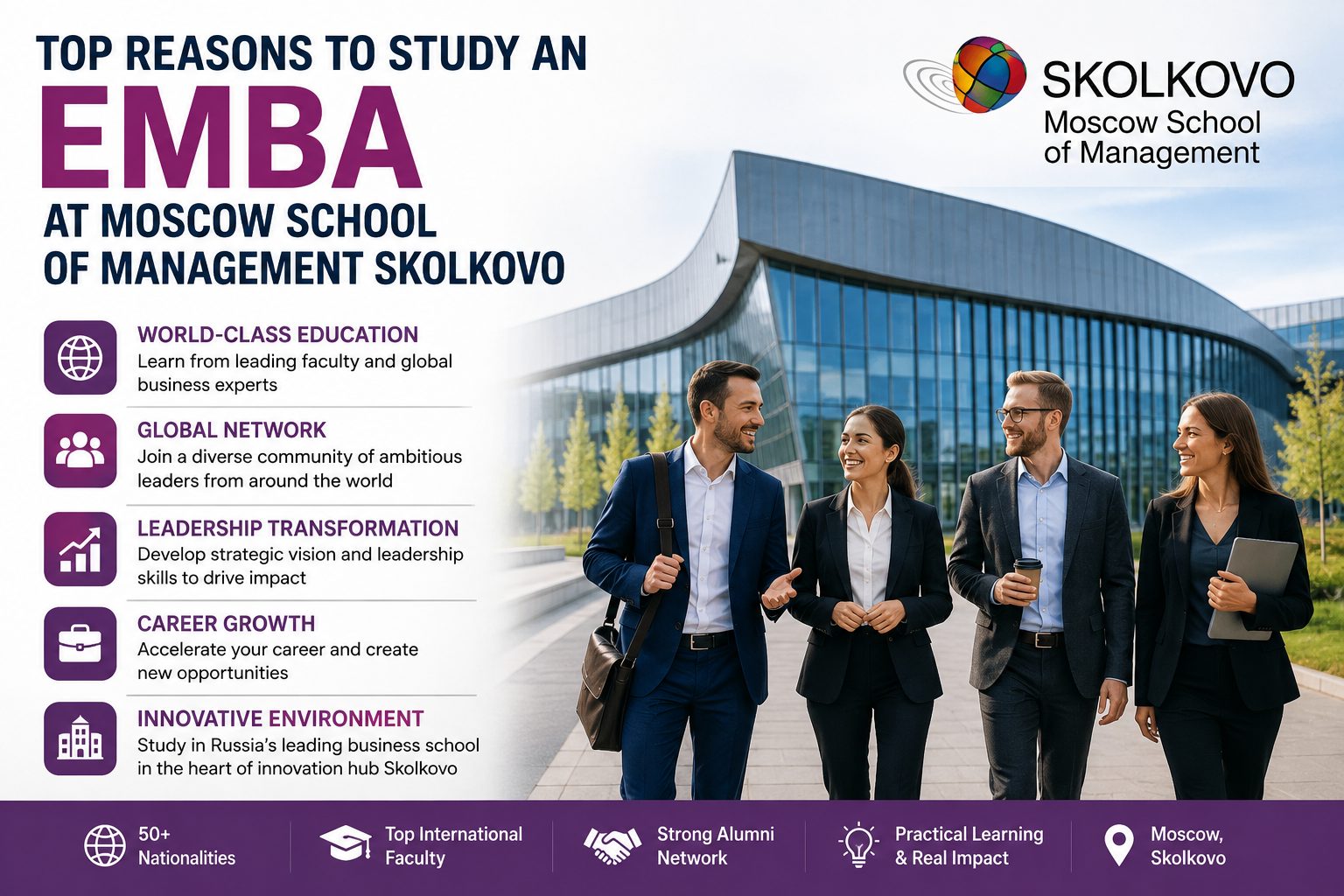
Discover the top reasons to study an EMBA at Moscow School of Management SKOLKOVO, from leadership skills to global opportunities.
Before diving into what SKOLKOVO's Executive MBA actually offers, it's worth being upfront about something a lot of older content on this topic glosses over: much of what's written online about studying business in Russia dates from before 2022, and the landscape has genuinely changed since. This article covers what the programme offers on its own academic merits, alongside the practical realities international applicants need to weigh honestly before applying in 2026.
What Is Moscow School of Management SKOLKOVO?
SKOLKOVO is the largest private business school in Russia, established in 2006 by 18 Russian and international companies and individuals spanning the oil and gas, metals, energy, investment, and banking sectors. Its campus, located in Skolkovo village outside Moscow, was designed by British architect David Adjaye, with a striking form conceived as a reflection on the work of artist Kazimir Malevich — the building itself is one of the school's most distinctive features.
SKOLKOVO built its academic identity around a "learning-by-doing" philosophy, emphasizing direct application of concepts to real business challenges rather than a purely theoretical case-study approach. The school offers two MBA cohorts annually, a standalone Executive MBA beginning each spring, and a joint dual-degree EMBA programme delivered in partnership with the Hong Kong University of Science and Technology (HKUST) Business School, marketed as the "EMBA for Eurasia."
What the EMBA for Eurasia Actually Offers
The joint SKOLKOVO–HKUST Executive MBA is built around a distinctive, genuinely multi-country delivery model. According to programme materials, modules have historically been delivered across seven locations: Russia (SKOLKOVO), China (HKUST), Switzerland (University of St. Gallen), the United States (UC Berkeley), Israel (Tel Aviv University), Kazakhstan (Nazarbayev University), and Armenia (UWC Dilijan) — with an explicit programme focus on "New Eurasia" and Belt and Road Initiative-related business dynamics.
Graduates of the programme receive two separate degrees — one from SKOLKOVO and one from HKUST — and the standard programme format runs 18 months, structured for working executives to combine study with continued employment.
Core coursework has included modules such as:
- Global Trends: Eurasia & the Fourth Industrial Revolution
- Leadership in Organizations
- Financial Accounting
- Strategic Marketing
- Managerial Decision-Making
- Corporate Governance
Faculty have historically been drawn from a mix of international business schools, including CEIBS, INSEAD, IMD, Cambridge, and IESE, alongside SKOLKOVO's own faculty — a structure designed to blend globally recognized teaching standards with deep regional expertise in Eurasian markets specifically.
The Case for the Programme
For the right candidate, SKOLKOVO's EMBA offers a few genuinely distinctive features:
- A dual degree from two institutions, rather than a single credential — SKOLKOVO and HKUST both carry their own regional reputations, giving graduates a combined credential spanning Russian/Eurasian and Asian business education systems.
- A module-based format specifically designed not to interfere with full-time work, a common EMBA structure but one SKOLKOVO markets as a central design principle.
- Deep, genuine focus on emerging and Eurasian markets — for executives specifically building a career oriented around Russia, Central Asia, or Belt and Road-adjacent markets, this kind of dedicated regional focus is relatively rare among globally branded EMBA programmes.
- A internationally sourced faculty roster, drawing instructors from well-regarded global business schools rather than relying solely on domestic faculty.
- A distinctive campus and "learning-by-doing" pedagogical identity, differentiating it from more conventional case-study-driven EMBA formats.
What's Changed Since 2022: Context Every Applicant Should Know
A significant amount of promotional content about SKOLKOVO in circulation still reflects the school's pre-2022 positioning. Since Russia's invasion of Ukraine, several material changes affect any international student — and especially Western students — considering study in Russia:
Academic Partnerships Have Been Affected
In 2022, the Global Network for Advanced Management (GNAM) announced the suspension of SKOLKOVO from its programming — a concrete example of how international academic network relationships tied to Russian institutions have shifted since the invasion. Applicants should independently verify the current status of any specific partner-institution relationship (including the HKUST joint degree) directly with SKOLKOVO, rather than relying on older marketing materials, since international academic partnerships involving Russian institutions have been in flux.
Banking and Payments Are Genuinely Complicated
Visa and Mastercard suspended operations in Russia in March 2022, meaning cards issued outside Russia generally don't work within the country, and Russian-issued cards don't work abroad. This creates real, practical friction for international students managing tuition payments, living expenses, and any cross-border financial transactions during their studies — a logistical issue worth planning around carefully rather than assuming normal international banking access.
Visa and Travel Logistics Have Grown More Complex
The EU, UK, US, and Canada have banned Russian aircraft from their airspace, meaning direct flight options from many Western countries no longer exist — travel typically requires routing through countries like the UAE, China, or Finland (via a land route into Finland from St. Petersburg, for applicants who can secure a Schengen visa). Visa and residency permit processing for international students in Russia has also become more complicated and time-consuming since 2022 according to multiple education-sector reports, which can affect whether students are able to begin their studies on schedule.
How a Russian Degree Is Perceived Varies Significantly by Region
Multiple current sources note that while some Western employers and universities may view a Russian degree with additional scrutiny since 2022, this concern applies considerably less in Asia, Africa, the Middle East, and Latin America, where Russian degrees generally remain well-regarded. If you're evaluating this programme, it's genuinely worth thinking through where you intend to build your post-EMBA career, since regional perception differs substantially.
No Post-Study Work Visa Pathway
Unlike destinations such as Canada or Germany, Russia does not offer a dedicated post-study work visa pathway for international graduates — a relevant factor if part of your motivation for pursuing an EMBA abroad includes establishing a longer-term presence in the country where you studied.
Who This Programme Is Genuinely Well-Suited For
Given the above, SKOLKOVO's EMBA is likely to be the strongest fit for:
- Executives and entrepreneurs already operating in, or specifically targeting, Russian, Central Asian, or wider Eurasian markets, where the programme's deep regional focus and network offer genuine, hard-to-replicate value
- Candidates based in Asia, the Middle East, Africa, or Latin America, where a Russian-affiliated business qualification generally carries less of the additional scrutiny reported in some Western markets
- Applicants who have already carefully researched and confirmed current banking, visa, and travel logistics, and are comfortable navigating the genuine practical complexity involved in studying in Russia under current international conditions
It's likely to be a considerably more complicated choice for candidates based in the US, UK, EU, or other Western countries, primarily due to the banking, travel, and visa friction described above — though ultimately this is a decision that depends on individual circumstances, career goals, and risk tolerance, which is why verifying current, first-hand information directly with SKOLKOVO before applying is essential.
How to Get Current, Accurate Information
Given how much has changed since much of the promotional content about this programme was originally written, prospective applicants should:
- Contact SKOLKOVO's admissions team directly for the current status of the HKUST joint degree partnership, current module locations, and up-to-date programme structure, since these have historically been subject to change.
- Independently verify current visa and travel logistics for your specific nationality, rather than relying on general or outdated guidance.
- Research current banking and payment workarounds used by other international students at the school, since standard international card and transfer options may not function as expected.
- Talk to recent or current international students, if possible, to get an honest, first-hand account of what studying there actually looks like under present conditions — this is likely to be more reliable than either older marketing content or general geopolitical commentary alone.
Frequently Asked Questions
Is Moscow School of Management SKOLKOVO still operating and admitting international students? As of recent reporting, yes — but the specific status of international partnerships, admissions processes, and logistics for applicants from different countries can change, so current details should be confirmed directly with the school before applying.
What degree do I receive from the EMBA for Eurasia programme? Historically, a dual degree — one from SKOLKOVO and one from HKUST Business School — though prospective applicants should confirm the current status of this partnership directly with SKOLKOVO, given documented disruptions to some of the school's international academic network relationships since 2022.
Can I use my international bank card while studying in Russia? Generally, no — Visa and Mastercard suspended operations in Russia in 2022, meaning cards issued outside the country typically don't function within it. International students need to plan alternative payment and banking arrangements in advance.
Is a Russian business degree respected internationally? It varies significantly by region. Reports suggest Russian degrees are viewed with more scrutiny in some Western markets since 2022, while remaining well-regarded across much of Asia, Africa, the Middle East, and Latin America.
Does SKOLKOVO offer a post-study work visa for international graduates? No — unlike countries such as Canada or Germany, Russia does not currently offer a dedicated post-study work visa pathway for international graduates.