
The Complete IELTS Test Guide: Everything You Need to Know (2026)
By chidx · Published 25 August 2026
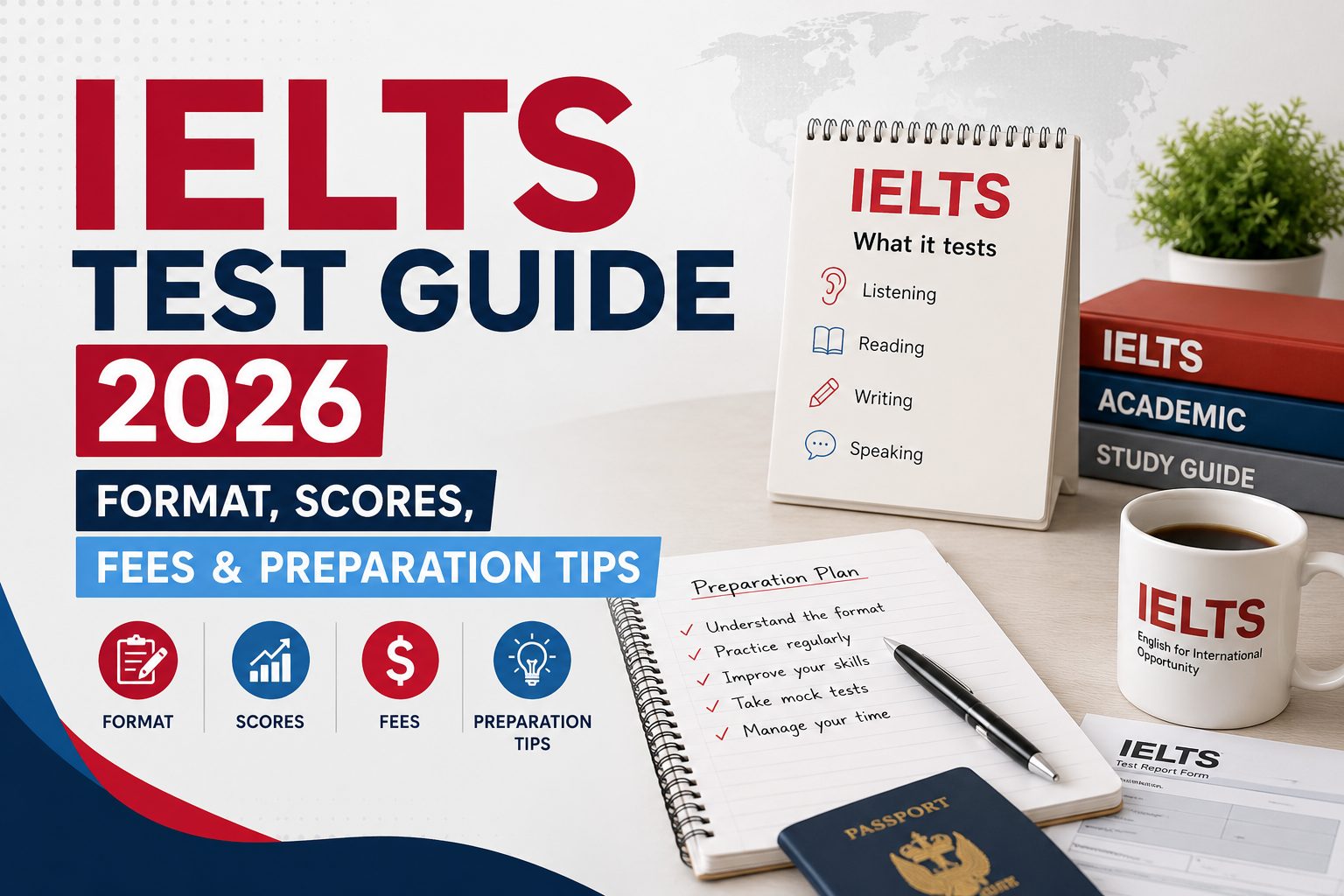
IELTS Test Guide 2026: Learn the format, scoring, preparation tips, and how to achieve your target band score.
The International English Language Testing System — IELTS — remains one of the most widely accepted English proficiency exams in the world, used by universities, employers, and immigration authorities across dozens of countries. But between Academic vs. General Training, band scoring, the shift away from paper-based testing, and fees that vary significantly by country, it's easy for first-time test-takers to feel lost before they've even booked a date. This guide covers everything you need to know about IELTS in 2026, from format and scoring to registration, fees, and preparation strategy.
Key Takeaways
- IELTS is scored on a Band Scale from 0 to 9 — there is no pass or fail; each institution or visa authority sets its own minimum required band.
- There are two versions: IELTS Academic (for university admission) and IELTS General Training (for work, migration, and permanent residency applications).
- The test has four sections — Listening, Reading, Writing, and Speaking — taking about 2 hours and 45 minutes in total.
- Paper-based IELTS is being discontinued globally by June 27, 2026 — after that date, all standard IELTS tests will be computer-delivered, with a Writing-on-paper hybrid available in select markets.
- IELTS scores are valid for two years from the test date.
- Fees vary significantly by country, generally equivalent to roughly USD 215–310, though exact pricing depends on location and test type (standard Academic/General Training vs. IELTS for UKVI).
What Is IELTS and Who Needs It?
IELTS measures English language proficiency across four core skills — listening, reading, writing, and speaking — and is jointly managed by the British Council, IDP: IELTS Australia, and Cambridge Assessment English. It's used by:
- Universities and colleges worldwide as an English proficiency requirement for admission
- Immigration authorities in countries like Canada, Australia, and the UK, as part of visa or permanent residency applications
- Employers and professional licensing bodies, particularly in healthcare and other regulated professions, as proof of workplace English proficiency
IELTS Academic vs. IELTS General Training: Which One Do You Need?
This is the single most common point of confusion for first-time test-takers, so it's worth getting right before you register.
- IELTS Academic is designed for people applying to university or college degree programs, or for professional registration in fields with academic entry requirements. If your goal is a degree program, you need Academic — full stop.
- IELTS General Training is designed for people applying for work, migration, or immigration purposes, including permanent residency applications in countries like Canada and Australia. Some employers and non-degree training programs also accept or require it.
Importantly:
- Listening and Speaking are identical across both versions — the content and format don't change.
- Only Reading and Writing differ. Academic Reading uses longer, more complex texts drawn from academic journals, books, and articles. General Training Reading uses shorter, more practical texts drawn from everyday and workplace contexts, such as notices and advertisements.
- A special "IELTS for UKVI" version exists for people applying to study below degree level in the UK (such as Foundation programs or A-levels) or for specific UK visa categories. The content is identical to standard IELTS — the difference is in how the test is administered and verified for immigration purposes, and it's often priced slightly higher.
If you're unsure which version your target university, employer, or visa route requires, always check their specific requirements before registering — booking the wrong version is a completely avoidable, and often costly, mistake.
IELTS Test Format: What to Expect
The full test takes approximately 2 hours and 45 minutes, broken into four sections:
Section
Duration
What It Tests
Listening
30 minutes
Understanding spoken English across a range of accents and contexts
Reading
60 minutes
Comprehension of written texts (content differs between Academic and General Training)
Writing
60 minutes
Two tasks: a shorter Task 1 and a longer, more heavily weighted Task 2
Speaking
11–14 minutes
A face-to-face (or computer-delivered) interview assessing fluency, pronunciation, and coherence
Listening and Speaking are identical for both Academic and General Training test-takers. Only Reading and Writing content differs between the two versions.
Writing Section Details
The Writing section consists of two tasks:
- Task 1 (about 20 minutes, minimum 150 words): In Academic, this typically involves describing a chart, graph, table, or diagram. In General Training, it's usually a letter (formal, semi-formal, or informal).
- Task 2 (about 40 minutes, minimum 250 words): An essay responding to a point of view, argument, or problem — the same general task type across both Academic and General Training.
Task 2 counts for roughly twice as much of the Writing band as Task 1, so time management between the two tasks matters significantly for your overall Writing score.
How IELTS Is Scored: The Band Scale Explained
IELTS uses a Band Scale from 0 to 9, with 9 representing an expert user of English and lower bands reflecting more limited proficiency. There's no pass or fail — instead, each institution, employer, or visa authority sets its own minimum band requirement based on its own criteria.
Here's how scoring actually works for each section:
- Listening and Reading are scored based on the number of correct answers out of 40 questions, converted into a band score using an official conversion table. Because Academic Reading passages are more complex, General Training test-takers generally need more correct answers to achieve the same band score as an Academic test-taker.
- Writing is assessed by trained examiners across four weighted criteria (each worth 25%): Task Achievement/Response, Coherence and Cohesion, Lexical Resource (vocabulary), and Grammatical Range and Accuracy.
- Speaking uses the same four-criterion framework, applied consistently by certified examiners worldwide.
- Your Overall Band Score is the average of your four section scores, rounded to the nearest 0.5. For example, scores of Listening 7.0, Reading 6.5, Writing 6.0, and Speaking 7.0 average to 6.625, which rounds up to an overall band of 6.5.
What Counts as a "Good" IELTS Score?
- 6.0–7.0 is generally considered a competitive range for university admissions, though specific requirements vary by program and institution.
- 6.5–7.5 is often required for more competitive university programs.
- A band of 7.0 places a test-taker at roughly the 85th percentile of all test-takers globally — a strong, above-average result.
- A band of 7.5 corresponds roughly to C1 on the CEFR scale, a strong result that meets entry requirements for the vast majority of universities worldwide.
- Many immigration programs, including in Canada and Australia, set minimum band requirements around 6.0 for various visa categories, though exact thresholds vary by program and country.
- For many test-taker populations, Writing and Speaking tend to be the weaker sections, while Listening and Reading typically score higher — worth keeping in mind when allocating study time.
Always check the specific band requirement for your target university, employer, or visa program before registering, since requirements vary significantly and can apply to both the overall band and individual section minimums.
The Big 2026 Change: The End of Paper-Based IELTS
One of the most significant changes to IELTS in recent memory is happening in 2026: paper-based IELTS is being discontinued globally by June 27, 2026. After that date, all standard IELTS tests will be delivered by computer, with a Writing-on-paper hybrid option available in select markets for test-takers who still prefer to handwrite their Writing responses.
A few practical implications of this shift:
- Test centers are transitioning rapidly. Most locations have already moved primarily to computer-delivered IELTS ahead of the global cutoff date.
- Timing changes slightly on computer-delivered IELTS. For example, computer-based Listening allows only about 2 minutes to review answers, compared to 10 minutes of answer-transfer time on the traditional paper format — a detail worth practicing for specifically if you're used to paper-based test prep materials.
- Fees generally remain the same regardless of computer-based or paper-based delivery, where paper-based is still temporarily available.
- If you strongly prefer handwriting, check whether your local test center still offers the Writing-on-paper hybrid option, since availability varies by market.
IELTS Fees in 2026: What It Costs by Region
IELTS pricing varies considerably by country and, in some markets, by city. As a general international benchmark, the standard test costs roughly USD 215–310 equivalent in most locations, with IELTS for UKVI typically priced somewhat higher due to additional administrative and security requirements. A few country-specific examples:
- India: Around INR 19,000 for both Academic and General Training as of 2026 (some sources cite a slightly lower range around INR 16,000–17,000 depending on city and provider — always confirm current local pricing).
- Canada: Roughly CAD 300–340, with some test centers charging a separate courier fee for result delivery.
- Hong Kong/Macau: Standardized pricing across major providers, with a modest premium for UKVI-specific tests; Macau pricing runs slightly higher, around HK$3,040 for the standard Academic test.
Because fees are updated periodically by local test centers, always confirm the exact current price directly on the official ielts.org site or with your local British Council/IDP test center before registering.
Retakes and Re-Marking
If you believe your score doesn't reflect your actual performance, you can apply for an Enquiry on Results (EOR), essentially a re-mark of your test. This typically costs around $100–120 USD in 2026 — but the fee is fully refunded if your score improves in any section after the re-mark, making it a relatively low-risk option if you have genuine reason to believe a section was scored incorrectly.
How Long Are IELTS Scores Valid?
IELTS band scores are valid for two years from the test date, for both Academic and General Training. This policy exists because language proficiency can change over time, particularly for people who aren't actively using English or living in an English-speaking environment — the two-year window gives institutions and immigration authorities a reasonably current picture of a candidate's actual proficiency. If your target institution or visa program requires a score and yours has expired, you'll need to retake the full test.
How to Register for IELTS
- Decide which version you need — Academic, General Training, or IELTS for UKVI — based on your specific university, employer, or visa requirement.
- Choose computer-delivered or paper-based (where still available), keeping the 2026 phase-out timeline in mind.
- Book through the official British Council or IDP: IELTS Australia website for your country, selecting an available test date and center.
- Pay the registration fee, which varies by country and test type.
- Bring valid, original identification (typically a passport) to your test appointment — the same ID used during registration.
- Complete Listening, Reading, and Writing in one sitting, with Speaking sometimes scheduled on the same day or a nearby date, depending on the test center.
Preparation Tips for a Strong Band Score
- Practice under real time constraints. Reading and Writing in particular are heavily time-pressured — practicing with a timer builds the pacing instinct you'll need on test day.
- Focus extra attention on Writing and Speaking if these are historically your weaker areas, which is common among many test-taker populations.
- Avoid memorized templates and clichéd phrases in Writing and Speaking. Examiners are specifically trained to identify formulaic, memorized responses, and authentic, well-structured language consistently scores better than rehearsed templates.
- Master Task 2 timing in Writing, since it counts for roughly twice as much of your Writing band as Task 1 — under-allocating time to Task 2 is one of the most common avoidable mistakes.
- Do full-length practice tests, not just section drills, to build the stamina needed for the full 2-hour-45-minute test.
- Familiarize yourself with computer-delivered mechanics if you're taking the newer format, especially the shorter answer-review window in Listening compared to the older paper-based process.
- Check your specific band requirement early, including whether your target institution needs a minimum score in every section, not just the overall band — some programs set individual section minimums that are easy to miss if you only track your overall average.
Frequently Asked Questions
What is the difference between IELTS Academic and General Training? Academic is for university and degree program admission; General Training is for work, migration, and immigration purposes. Listening and Speaking are identical between the two; only Reading and Writing content differs.
Is IELTS scored pass or fail? No. IELTS uses a Band Scale from 0 to 9, and each institution or authority sets its own minimum required score — there's no universal pass or fail threshold.
How long is an IELTS score valid? Two years from the test date, for both Academic and General Training.
Is paper-based IELTS still available in 2026? It's being phased out globally, with a cutoff date of June 27, 2026, after which all standard IELTS testing moves to computer-delivered format, though a Writing-on-paper hybrid remains available in select markets.
How much does IELTS cost? Fees vary by country, generally equivalent to roughly USD 215–310, though exact pricing depends on your location and whether you're taking standard IELTS or IELTS for UKVI. Always confirm current local pricing before registering.
What is a good IELTS score for university admission? Most competitive university programs require a band between 6.0 and 7.5, though specific requirements vary significantly by institution and program — always check your target school's exact requirement.
Can I retake just one section of IELTS if I'm unhappy with my score? No, IELTS doesn't offer single-section retakes for a standard retest — you'd need to sit the full test again. However, if you believe a specific section was scored incorrectly, you can apply for a paid re-mark (Enquiry on Results), which is refunded if your score improves.