
Study Abroad Beyond the US and Canada: Best Destinations for Students
By chidx · Published 28 August 2026
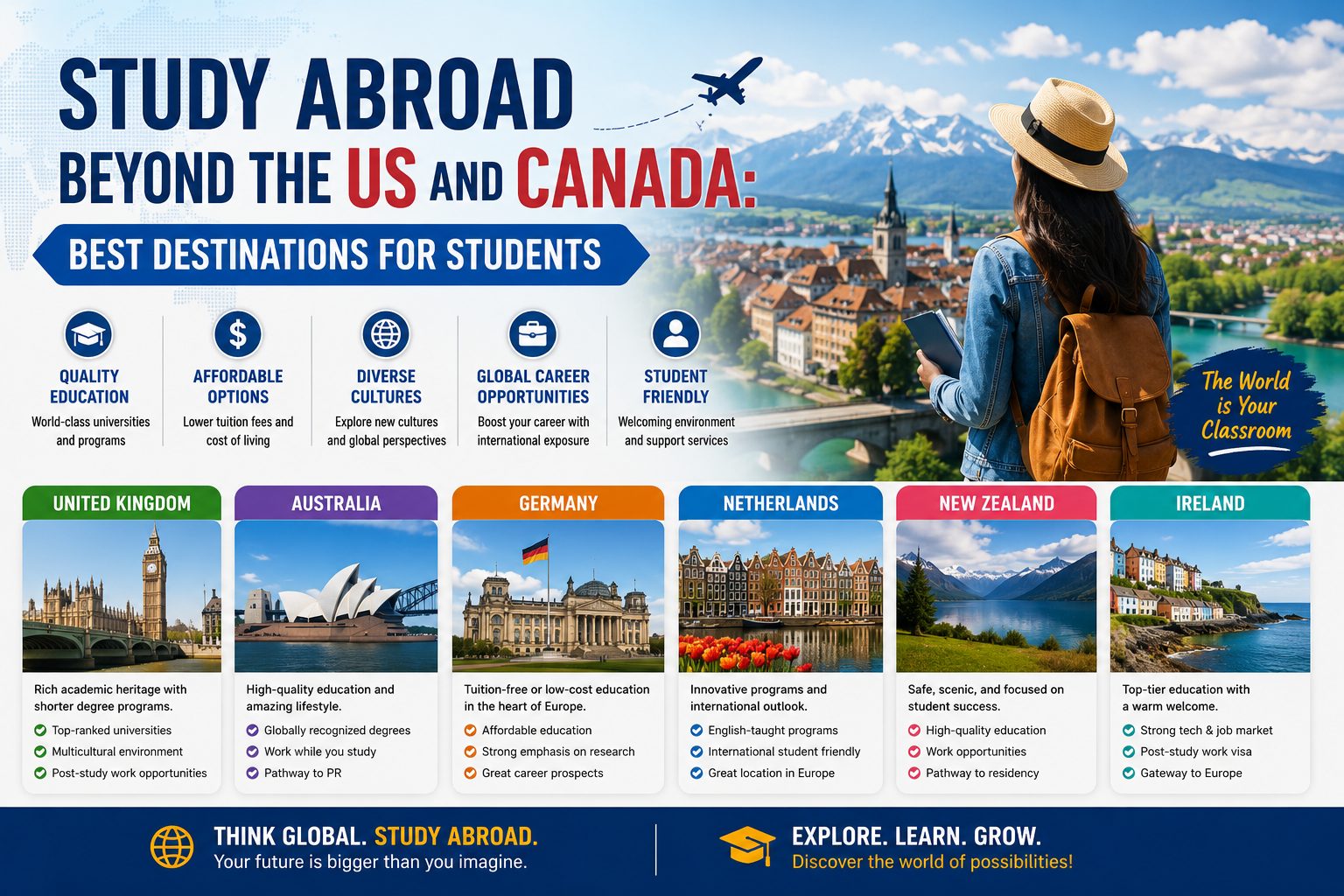
Explore the best study abroad destinations beyond the US and Canada, with top options, costs, benefits and student tips.
For decades, studying abroad meant one thing to most students: the United States or Canada. But 2026 has brought a major shift in how international students think about their options. Rising tuition costs, tightening visa policies, and increasingly unpredictable approval rates in the traditional "Big Four" (US, UK, Canada, Australia) are pushing students to look further afield — and what they're finding is often just as good, if not better.
From tuition-free universities in Germany to English-taught programs in the Netherlands and fast-growing education hubs in Asia, today's alternatives offer world-class academics, lower costs, and genuine post-study career pathways. This guide breaks down the best destinations to study abroad beyond the US and Canada, and what makes each one worth considering.
Why Students Are Looking Beyond the US and Canada
The reasons behind this shift are practical, not just about variety. Visa rejection rates have climbed in the US in particular, and many students are wary of investing tens of thousands of dollars in an application that might not succeed. At the same time, tuition and living costs in traditional destinations have continued to rise, while several alternative countries offer low or even free tuition at public universities.
Beyond cost, students are increasingly prioritizing return on investment — meaning affordable education, clear post-study work rights, and realistic pathways to long-term career or residency options — over sheer institutional prestige.
Top Study Abroad Destinations Beyond the US and Canada
1. Germany — Tuition-Free Excellence
Germany continues to be one of the most attractive destinations for international students, largely because most public universities charge little to no tuition, even for international students, while still delivering globally respected degrees in engineering, business, and the sciences.
Why it stands out:
- Free or near-free tuition at public universities
- Strong job market in engineering, automotive, and technology sectors
- Growing number of English-taught master's programs
- Post-study work visa allows graduates to stay and search for a job
Best for: STEM students, engineers, and anyone looking for high-quality education without heavy tuition costs.
2. Ireland — Europe's English-Speaking Hub
Ireland has quietly become one of Europe's most popular alternatives for students who want an English-speaking environment without applying to the UK. With a thriving tech sector — home to European headquarters for major global companies — Ireland offers strong career prospects alongside a high quality of life.
Best for: Business, tech, and pharmaceutical students seeking an English-taught degree with strong industry connections.
3. The Netherlands — English-Taught Degrees, European Quality
The Netherlands has built one of the most extensive networks of English-taught degree programs anywhere in Europe, making it easy for international students to study at a high level without needing to learn Dutch first.
Why it stands out:
- Hundreds of English-taught bachelor's and master's programs
- Highly ranked universities with strong research output
- Central location for exploring the rest of Europe
- Relatively affordable compared to the UK or US
Best for: Students who want an English-language European degree with strong international recognition.
4. Singapore — Asia's Global Education Hub
Singapore has positioned itself as one of Asia's premier study destinations, home to top-ranked universities such as NUS (National University of Singapore) and NTU (Nanyang Technological University). It combines rigorous academics with a safe, ultra-modern city environment and strong links to Asia-Pacific job markets.
Best for: Students targeting careers in finance, technology, or business within the Asia-Pacific region.
5. South Korea — Innovation Meets Culture
South Korea has become one of the standout destinations for 2026, with Seoul topping recent global rankings for student cities thanks to its academic rigor, safety, and affordability. Universities like Seoul National University, KAIST, and Yonsei University are particularly strong in engineering, computer science, and AI-related fields.
Why it stands out:
- Cutting-edge programs in AI, engineering, and computer science
- Lower cost of living than most Western study destinations
- Vibrant cultural scene, from K-pop to street food
- Increasingly popular with STEM-focused international students
Best for: STEM students and anyone drawn to South Korea's blend of tradition and modern innovation.
6. Malaysia — Affordable Quality in Southeast Asia
Malaysia has emerged as a fast-rising study destination thanks to its combination of affordable tuition, high-quality English-taught programs, and branch campuses of well-known international universities. It offers a lower cost of living than most of its regional competitors while still delivering internationally recognized degrees.
Best for: Budget-conscious students who still want access to globally branded university programs.
7. Hungary — A Rising Choice for Medicine and Engineering
Hungary has grown in popularity, particularly for medical and engineering programs, offering quality education at a fraction of the cost of Western Europe or North America. Its universities are increasingly recognized internationally, and its central European location makes travel across the continent easy.
Best for: Students pursuing medicine, dentistry, or engineering on a tighter budget.
8. United Arab Emirates (Dubai) — A New Global Campus Hub
Dubai has rapidly transformed into a major study destination, now hosting dozens of international branch campuses from universities based in the US, UK, and Australia. Students can earn a globally recognized degree from institutions like the University of Wollongong or New York University Abu Dhabi, while gaining direct exposure to Dubai's booming finance, technology, and business sectors.
Best for: Business and finance students who want a global-brand degree with strong regional career opportunities.
9. Italy and Spain — Affordable Western Europe
Italy and Spain offer a compelling combination of relatively low tuition, rich cultural experiences, and access to the broader European job market. Public universities in both countries tend to be significantly more budget-friendly than comparable institutions in the US or UK, without sacrificing academic quality or global recognition.
Best for: Students interested in design, art, architecture, humanities, or business, who also want an immersive cultural experience.
10. New Zealand — Quality of Life Meets Career Opportunity
New Zealand offers a combination of strong academics, a high quality of life, and accessible post-study work rights, making it an appealing alternative to its larger neighbor, Australia, often with a calmer pace of life and lower overall competition for spots.
Best for: Students who want an English-speaking Western education experience without the intensity of larger traditional destinations.
How to Choose the Right Destination for You
With so many strong alternatives available, choosing the right country comes down to weighing a few key factors against your own priorities:
- Budget: Countries like Germany, Hungary, and Malaysia offer significantly lower tuition and living costs than the US, UK, or Australia.
- Language of instruction: If you're not ready to learn a new language, prioritize destinations with well-established English-taught programs, such as the Netherlands, Ireland, or Singapore.
- Career goals: Match your destination to your industry — Germany and South Korea for engineering and tech, Singapore and Dubai for finance and business, Ireland for pharma and tech.
- Post-study work rights: Research each country's rules on staying to work after graduation, as these vary significantly and can affect your long-term career and immigration options.
- Cultural fit and lifestyle: Consider climate, safety, cultural environment, and how far you're comfortable being from home.
Final Thoughts
The US and Canada are no longer the automatic default for students planning to study abroad — and that's a good thing. Countries across Europe, Asia, and the Middle East are actively competing for international students, offering world-class education, lower costs, and often more predictable visa pathways than the traditional Big Four.
Rather than limiting your search to the most familiar names, take time to explore destinations that align with your budget, career goals, and personal priorities. In 2026, some of the best opportunities in global education are found well beyond the countries most students consider first.