
Student Visa Rejections in 2026: Common Reasons and What to Do Next
By chidx · Published 28 August 2026
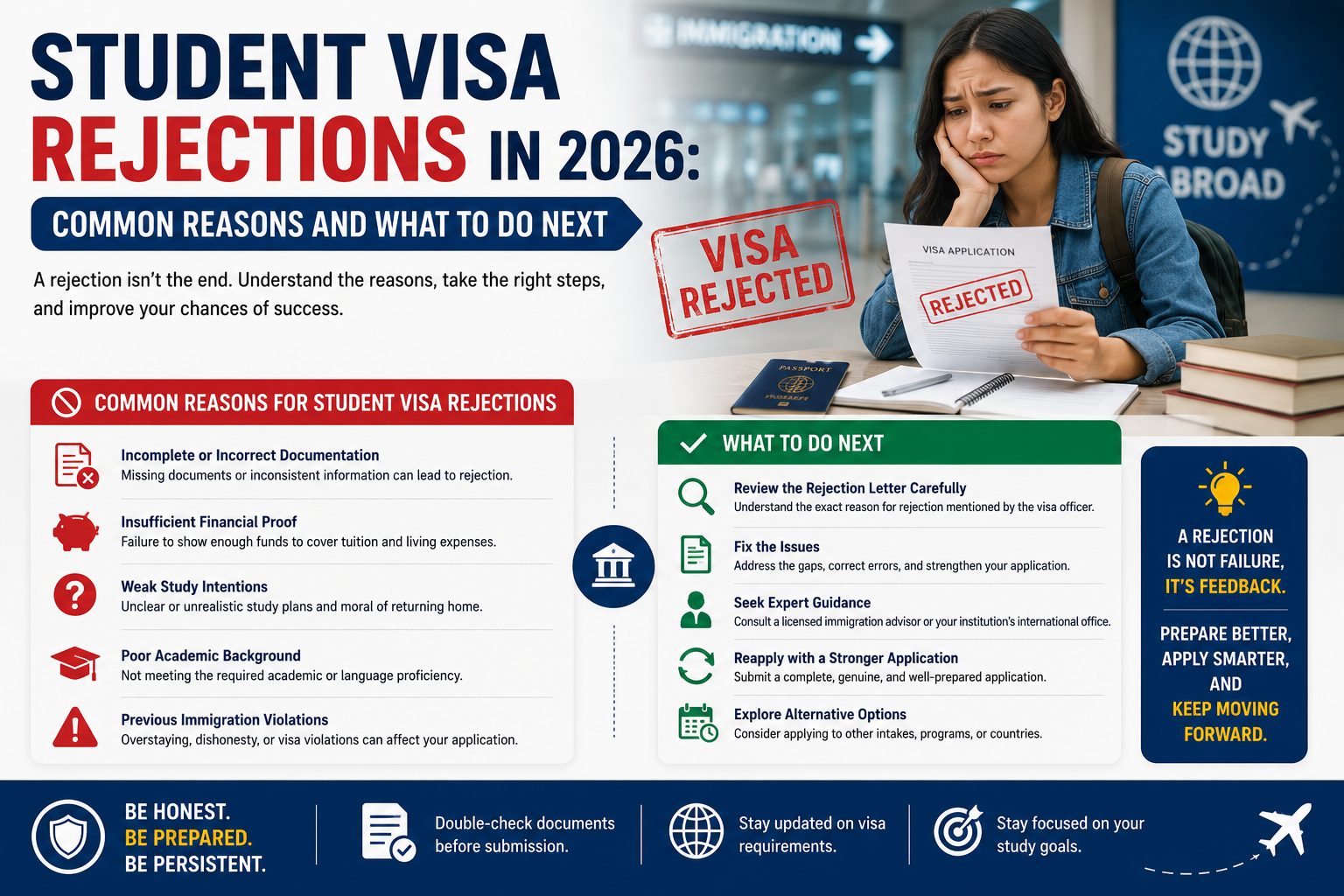
Learn the common reasons for student visa rejections in 2026 and discover what to do next to improve your chances.
Getting a student visa rejected can feel like a devastating setback, especially after months of preparation, application fees, and excitement about studying abroad. But a rejection is not the end of the road. Across major study destinations — the United States, United Kingdom, Canada, and Australia — visa authorities are applying more rigorous scrutiny in 2026 than in previous years, which means more applicants are running into refusals even when their academic profiles are strong.
This guide walks through exactly why student visas are being rejected in 2026, and — more importantly — what you can do next to turn a rejection into an eventual approval.
Why Student Visa Rejections Are Rising in 2026
Immigration authorities in the US, UK, Canada, and Australia are conducting more detailed reviews of student applications this year, cross-checking financial records, academic history, and stated intentions more closely than before. In the US specifically, F1 visa applicants have faced a rejection rate of roughly 36%, with the majority of refusals falling under Section 214(b) — the provision requiring applicants to prove they don't intend to abandon their home country permanently.
This tighter environment doesn't mean your chances are hopeless. It means the margin for error is smaller, and understanding exactly what visa officers are looking for has become essential.
Common Reasons Student Visas Get Rejected in 2026
1. Weak or Insufficient Financial Proof
Financial documentation remains the single most common cause of visa refusal. Visa officers need clear, verifiable evidence that you (or your sponsor) can cover tuition and living expenses for the full duration of your program — often in the range of $60,000–$100,000 for US programs, with similar inflation-adjusted thresholds now applied in the UK, Canada, and Australia.
Red flags that trigger rejection include:
- Bank balances that don't match your stated funding source
- Large, unexplained deposits shortly before applying
- Unclear or informal sponsorship arrangements
- Fund amounts that fall short of official minimum requirements
2. Failure to Prove "Non-Immigrant Intent"
Especially in the US, visa officers must be convinced your primary purpose is education — not a pathway to permanent migration. This concern has grown sharper as more countries offer post-study work visas, making authorities more suspicious that a student visa is being used as a backdoor immigration route.
To address this, your application needs to clearly demonstrate strong ties to your home country: family responsibilities, career prospects, property, or other commitments that show you have a compelling reason to return after your studies.
3. Inconsistent or Generic Statement of Purpose (SOP)
Your SOP is one of the most heavily scrutinized parts of your application. Visa officers increasingly flag SOPs that feel generic, copy-pasted, or disconnected from the applicant's actual academic background. Inconsistencies between your SOP, your DS-160 (or equivalent) form, and your interview answers are an especially common trigger for rejection.
A strong SOP should clearly connect your past education, your chosen program, and your future career goals into one coherent narrative — not just describe the course you want to take.
4. Documentation Errors and Mismatches
Simple clerical issues remain surprisingly common causes of refusal. A name spelled differently across documents, a mismatched date of birth, an expired transcript, or missing supporting certificates can all lead to rejection — even when every other part of the application is strong. Visa officers often scan applications for red flags rather than reading every detail closely, so even a minor mismatch can stand out.
5. Weak Academic Progression or Unexplained Gaps
A noticeable gap between your previous qualifications and your chosen course — such as switching fields entirely without explanation, or applying for a program at a lower academic level than you've already completed — can raise questions about your genuine intent to study. Career changes and study gaps aren't automatically disqualifying, but they need to be clearly explained and justified within your SOP.
6. Low or Expired English Language Test Scores
IELTS, TOEFL, PTE, or equivalent scores that fall below the required threshold — or that have expired by the time of your application — are an easy and avoidable rejection reason. In 2026, borderline scores are being scrutinized more closely than before, so it's worth aiming comfortably above the minimum requirement rather than just meeting it.
7. Questionable Institution or Course Choice
Choosing a lesser-known, unaccredited, or seemingly mismatched institution can raise doubts about the credibility of your study plans. Visa officers may question why you're pursuing a specific program at a specific school if it doesn't align logically with your academic background or career goals.
8. Poor Interview Performance
For countries that require an in-person or virtual interview, how you present yourself matters as much as what's on paper. Overconfident, rehearsed-sounding answers can appear scripted and insincere, while extreme nervousness can come across as evasiveness. Visa officers are trained to notice inconsistency between your spoken answers and your written application.
9. Past Immigration History Issues
Previous visa refusals, overstays, unexplained gaps in travel history, or prior visa revocations increase scrutiny significantly. Even unrelated issues — such as a past arrest or public involvement in political activism — have reportedly contributed to increased scrutiny and, in some cases, visa terminations for students already studying abroad.
10. Missing or Inadequate Health Insurance
Many countries now require proof of valid health insurance coverage for the full duration of your stay as a condition of visa approval. Skipping this step, or providing insurance that doesn't meet minimum coverage requirements, can result in an otherwise strong application being refused.
What to Do Immediately After a Visa Rejection
A rejection is disappointing, but it's rarely final. Here's how to respond constructively.
Step 1: Read the Rejection Letter Carefully
Visa refusal letters typically state the specific reason (or reasons) for rejection, whether it's a specific code like Section 214(b) or a general note about incomplete documentation. Don't skim this — the exact wording often points directly to what needs fixing.
Step 2: Identify the Root Cause, Not Just the Symptom
If your visa was rejected for "insufficient funds," ask deeper questions: Was the amount actually too low, or was the source of funds unclear? If it was rejected for "weak ties to home country," consider whether your SOP and interview answers actually communicated your future plans convincingly. Fixing the real issue — not just resubmitting the same documents — is what separates a successful reapplication from a repeated rejection.
Step 3: Strengthen Your Financial Documentation
If finances were a factor, work with your bank or sponsor to build a clearer paper trail. Avoid last-minute large deposits, and make sure fund amounts comfortably exceed the minimum requirement rather than just meeting it.
Step 4: Rewrite Your Statement of Purpose
If your SOP was flagged as generic or inconsistent, don't just tweak a few sentences — rewrite it. Focus on creating a clear, honest narrative that connects your academic history, your reasons for choosing this specific program and institution, and your plans after graduation.
Step 5: Address Ties to Your Home Country
Include concrete, verifiable evidence of your intent to return home: a job offer, family business involvement, property ownership, or a clear career plan that depends on returning with a foreign qualification.
Step 6: Practice for the Interview
If your visa involves an interview, rehearse — but not to the point of sounding scripted. Focus on being able to explain your study plans, financial situation, and future goals naturally and consistently, in your own words.
Step 7: Consider Professional Guidance
Immigration consultants or education counselors who specialize in your destination country can help identify blind spots in your application that are easy to miss on your own. This is particularly useful if you've been rejected more than once.
Step 8: Know When to Reapply — and When to Consider Alternatives
In most cases, you can reapply once you've addressed the root cause of the rejection. However, rushing a reapplication with the same weaknesses is likely to result in another refusal. Take the time needed to genuinely strengthen your application before resubmitting.
If repeated rejections become a pattern, it may also be worth broadening your options. English-taught degree programs are increasingly available across Europe and Asia, often at a lower cost than the US, UK, Canada, or Australia, and some destinations currently have less competitive visa processes for international students.
Final Thoughts
Student visa rejections in 2026 are being driven primarily by financial documentation gaps, unclear intent, inconsistent paperwork, and weak Statements of Purpose — not by a lack of academic merit. The good news is that nearly all of these issues are fixable with careful preparation, honest documentation, and a clear, consistent narrative across every part of your application.
Rather than viewing a rejection as a final verdict, treat it as specific feedback on what needs to be stronger next time. With the right adjustments — and patience — a rejected application can absolutely become an approved one.