
Scotland Scholarships for International Students: Funding Opportunities
By chidx · Published 26 August 2026
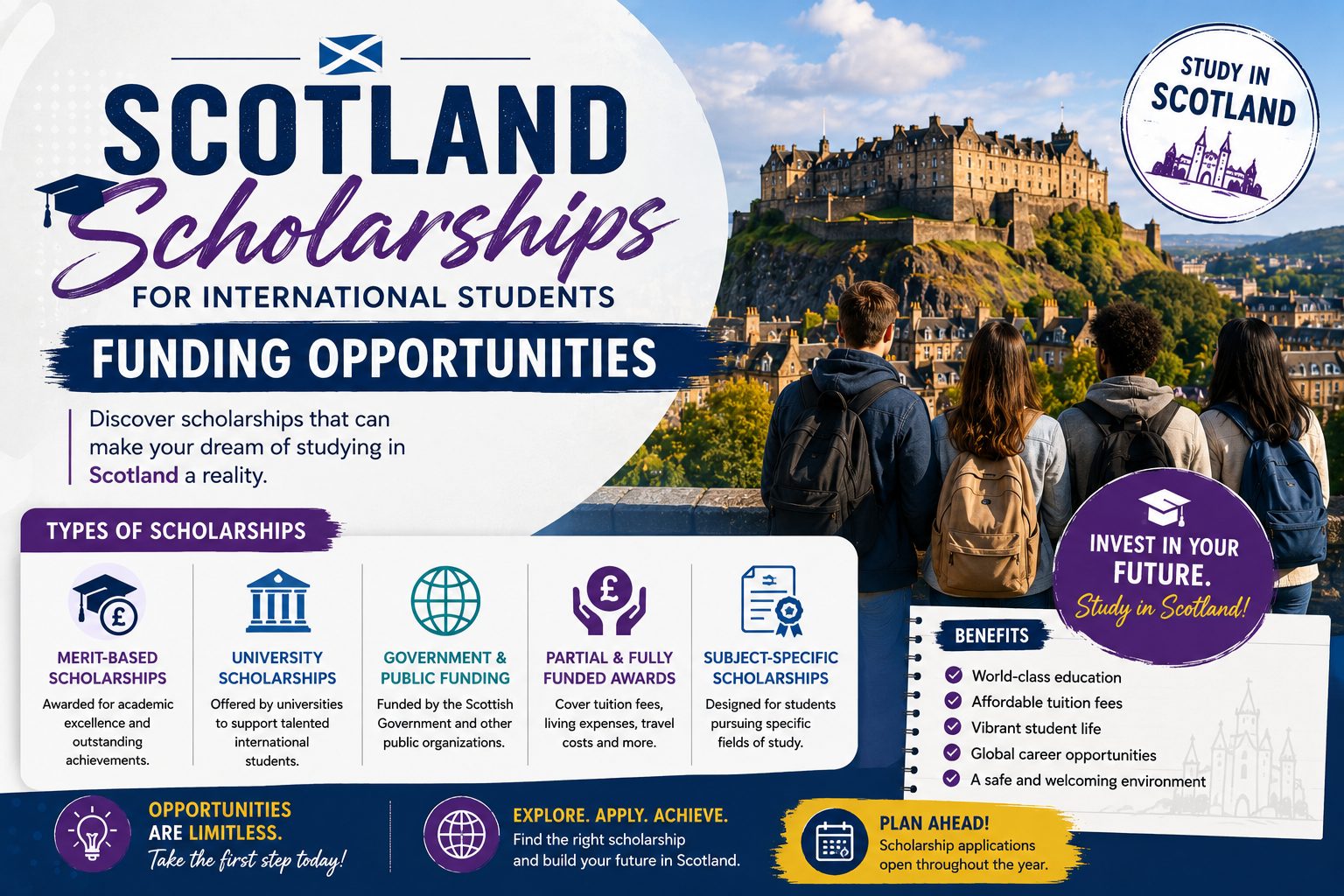
Scotland Scholarships for International Students: Explore funding options, eligibility, benefits, and application tips.
Scotland is home to 19 universities and welcomes tens of thousands of international students every year — but tuition and living costs can still feel out of reach without financial support. The good news is that Scotland offers one of the richest scholarship landscapes in the UK, with funding available from the Scottish Government, individual universities, and UK-wide programs backed by the British Council.
This guide walks through the major scholarship opportunities available to international students planning to study in Scotland, how they work, and how to build a strong application.
Why Scotland Offers Strong Scholarship Opportunities
Every university in Scotland offers scholarships for international students, ranging from partial tuition subsidies to full living-cost allowances. This is partly a reflection of how competitive Scotland has become as a study destination — with strong universities competing globally for talented students — and partly a result of dedicated government-backed funding programs designed specifically to make Scottish education accessible to students from a wide range of countries.
Combined with the fact that many Scottish master's programs run for just one year rather than two, scholarships can significantly reduce the total cost of a Scottish degree compared to longer programs elsewhere.
Scottish Government Scholarships
The Scottish Government funds several scholarship programs aimed specifically at international students, often with a focus on countries with historic ties to Scotland or specific development priorities.
Saltire Scholarships
The Saltire Scholarships are one of the most well-known funding programs for international students in Scotland. To be eligible, applicants generally need to:
- Be an international student from outside the UK or EU
- Hold an offer for a full-time undergraduate or postgraduate course at a Scottish university or college
- Have a strong academic record
- Submit a compelling research proposal (for postgraduate applicants)
- Demonstrate a commitment to making a positive contribution to society through their studies
Applications are assessed by a recruitment panel based on merit, so a well-prepared personal statement and research proposal (where applicable) are essential.
Country-Specific Scottish Government Scholarships
The Scottish Government also funds targeted scholarship programs for students from specific countries and demographics. Recent examples include the Scotland Pakistan Scholarships for Young Women and Girls, which fund undergraduate study in fields like education, sustainable energy, food security, agriculture, climate, and health sciences, covering tuition, accommodation, and travel costs. Programs like this typically rotate or update year to year, so it's worth checking current listings for your specific country of origin.
GREAT Scholarships: UK-Wide Funding Available in Scotland
The GREAT Scholarships programme is one of the most substantial funding opportunities available to international postgraduate students studying anywhere in the UK, including Scotland. It's a partnership between the UK government's GREAT Britain Campaign and the British Council, delivered in cooperation with individual universities.
Key details:
- Scholarships are worth a minimum of £10,000 toward tuition fees for one-year taught postgraduate programs.
- For the 2026–27 academic year, more than 140 individual scholarships are being offered across over 60 participating universities in England, Scotland, Wales, and Northern Ireland.
- The University of Edinburgh is among the Scottish universities participating, with awards typically restricted to specific nationalities each year (recent cycles have included students from Thailand, Mexico, and Ghana).
- Eligible nationalities vary by year but have recently included students from countries such as Bangladesh, China, Egypt, Ghana, India, Indonesia, Kenya, Malaysia, Mexico, Nigeria, Pakistan, Thailand, Turkey, and Vietnam, among others across roughly 18 participating countries.
Eligibility generally requires:
- Citizenship and passport holder status from an eligible country
- A conditional or unconditional offer for a full-time, one-year postgraduate course
- English language proficiency, typically around IELTS 6.5 overall with no band below 6.0
- A willingness to act as a program ambassador and participate in networking and academic events during the year
Because GREAT Scholarships are partial awards rather than full-tuition grants, many students combine them with university-specific scholarships or personal funding to cover the remaining balance.
University-Specific Scholarships in Scotland
Beyond national programs, individual Scottish universities run their own scholarship schemes, often with different eligibility rules, subject focuses, and funding levels.
University of Edinburgh
Edinburgh offers a range of postgraduate funding, including its participation in the GREAT Scholarships programme and various fully funded PhD scholarships across different schools and departments. Funding opportunities are frequently subject-specific, so applicants should check the funding pages for their particular department or school.
University of St Andrews
St Andrews runs a dedicated International Undergraduate Scholarship program to support high-achieving international applicants, along with additional funding routes for specific circumstances, including support for care-experienced and estranged students.
University of the West of Scotland
The University of the West of Scotland has offered scholarships of up to 40% off tuition fees for eligible international students during certain intake periods, making it a strong option for students prioritizing affordability alongside academic quality.
Other Scottish Universities
Most other Scottish institutions — including the University of Glasgow, University of Dundee, University of Aberdeen, University of Stirling, and Heriot-Watt University — maintain their own scholarship pages covering a mix of merit-based awards, subject-specific funding, and need-based support. Because offerings change frequently and vary significantly by program, checking each university's official international scholarships page directly is the most reliable way to find current opportunities.
Types of Scholarships Available
When researching funding options, it helps to understand the different categories of support you might come across:
- Fully funded scholarships: Cover tuition, and sometimes accommodation, travel, and living costs — typically highly competitive and merit-based.
- Partial tuition scholarships: Reduce tuition fees by a fixed amount or percentage (such as the GREAT Scholarships' £10,000 award, or a university's 40% tuition reduction).
- Country-specific scholarships: Targeted at students from particular nations, often tied to government partnerships or historical ties with Scotland.
- Subject-specific scholarships: Aimed at students in particular fields, such as STEM, social sciences, or sustainable energy.
- Need-based and circumstance-based scholarships: Designed for students facing specific financial or personal circumstances, such as care-experienced or estranged students.
Eligibility Criteria Common Across Scottish Scholarships
While specific requirements vary by program, most Scotland-based scholarships for international students share some common eligibility expectations:
- A strong academic record from your previous qualification
- An offer letter (conditional or unconditional) from a Scottish university
- Proof of English language proficiency, typically through IELTS or an equivalent test
- A well-written personal statement or research proposal, particularly for postgraduate and PhD funding
- Meeting specific nationality requirements, where applicable
- Not having previously studied in Scotland under a scholarship, for certain programs
How to Strengthen Your Scholarship Application
Competition for scholarship funding is significant, so a generic application is unlikely to succeed. Consider these steps to strengthen your chances:
- Start early. Many scholarship deadlines fall well before university application deadlines, so research funding options as soon as you begin planning your application.
- Tailor your personal statement or research proposal to the specific scholarship and its stated priorities, rather than reusing a generic essay across multiple applications.
- Secure your university offer first, where required — many scholarships, including GREAT Scholarships, require a conditional or unconditional offer before you can apply.
- Meet English language requirements comfortably, rather than just scraping the minimum threshold.
- Apply to multiple scholarships simultaneously where eligibility allows, since scholarships can often be combined or used as backup options if one application is unsuccessful.
- Check country-specific pages directly on university and program websites, since eligible nationalities and available amounts often change from year to year.
Where to Search for Current Scholarship Listings
Because scholarship availability, deadlines, and eligible countries shift each academic year, the most reliable approach is to check official sources directly rather than relying solely on secondhand summaries:
- The official Scotland.org scholarships page, which lists government-backed funding opportunities
- The Study UK website run by the British Council, for GREAT Scholarships and other UK-wide funding
- Individual university international scholarships pages, which are updated as new intakes and funding cycles open
Final Thoughts
Scotland offers a genuinely wide range of funding opportunities for international students, from government-backed programs like the Saltire Scholarships and GREAT Scholarships to university-specific awards covering everything from partial tuition reductions to fully funded degrees. While competition for these opportunities is real, the sheer number of programs — spanning nationalities, subjects, and degree levels — means there's a meaningful chance of finding funding that fits your specific situation.
The key is starting early, researching thoroughly, and tailoring each application to the specific scholarship rather than treating funding as an afterthought. With the right preparation, studying in Scotland can be significantly more affordable than many students initially assume.