
Provisional Admission: What It Means and What You Should Do Next
By chidx · Published 28 August 2026
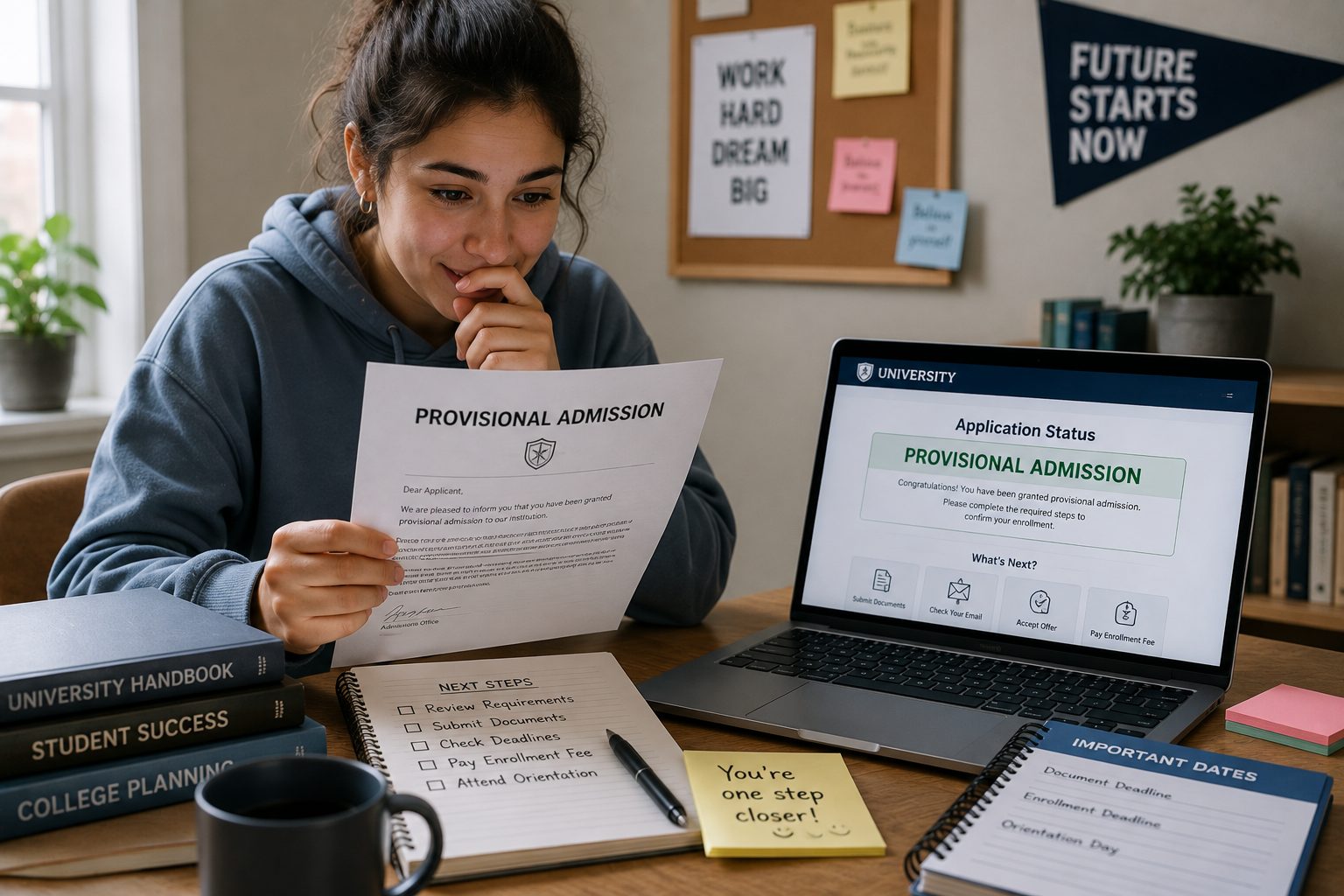
Understand provisional admission, what it means for your university application, key conditions to meet, and what to do next.
You open your admissions portal expecting a straightforward "accepted" or "rejected," and instead you see something in between: provisional admission. It's not a rejection. It's not quite a full acceptance either. For many students — especially international applicants — this ambiguous middle ground can feel more stressful than an outright decision. This guide explains exactly what provisional admission means, why schools use it, and the specific steps you need to take to turn it into a full, unconditional offer.
Key Takeaways
- Provisional admission (also called conditional admission or conditional acceptance) means a school has offered you a place, but only if you meet specific conditions by a set deadline.
- It is not the same as being waitlisted or deferred — you've genuinely been granted admission; you just have outstanding requirements to clear before it becomes final.
- Common conditions include final transcripts, minimum GPA maintenance, outstanding test scores, English language proficiency, or missing application documents.
- Provisional status can affect registration, financial aid, housing, and — for international students — visa applications, so it's worth taking seriously rather than treating it as a formality.
- The single best response is to treat your offer letter like a checklist with deadlines: identify every condition, get confirmation in writing, and clear each requirement as early as possible.
- If you decide not to attend, most schools require you to formally decline the offer — some, like UCSF, use a specific form confirming the decision is final.
What Provisional Admission Actually Means
Provisional admission means a college or university has admitted you, but at least one requirement remains unresolved — and the school is allowing you to move forward only under stated conditions until that gap is closed. In practical terms, you've been accepted, but your enrollment is not yet fully secured the way a student with an unconditional offer's enrollment is.
This is genuinely different from two other statuses students sometimes confuse it with:
- It is not the same as being waitlisted. A waitlisted applicant hasn't been admitted at all — they're being considered pending space availability. A provisionally admitted student has been admitted; they just have specific conditions left to fulfill.
- It is not the same as being deferred. A deferred decision means the school hasn't made a final call yet and will revisit your application later, typically in a subsequent round. Provisional admission is an actual offer, just one with strings attached.
Once you satisfy every listed condition, your offer becomes unconditional — a full, regular acceptance with no remaining requirements.
Why Schools Use Provisional Admission
Provisional admission exists because a huge number of applicants apply to college before every piece of their academic record is finalized. Common scenarios include:
- You're still finishing high school or a prior degree when you apply, so your final transcript and GPA aren't available yet.
- You're waiting on a standardized test score or retake, such as the SAT, ACT, IELTS, or TOEFL.
- Your English proficiency score falls just under the school's minimum requirement, but the school is willing to admit you contingent on additional coursework or a retest.
- Part of your application is administratively incomplete — a missing recommendation letter, an unverified document, or an outstanding form.
- You need to maintain a certain academic standard going forward — for example, some universities admit high school seniors provisionally, contingent on maintaining a minimum GPA through graduation.
By offering conditional admission rather than making applicants wait until every document is finalized, schools can give students earlier clarity and more time to plan — while still protecting their own academic standards by keeping the offer conditional until requirements are actually met.
Common Types of Conditions
Provisional admission conditions generally fall into a few recurring categories:
Academic Conditions
- Submitting a final transcript showing successful graduation or degree completion
- Maintaining a minimum GPA through the remainder of high school or a current degree program
- Completing specific coursework or prerequisites not yet finished at the time of application
- Completing a minimum number of credit hours within a specified timeframe after enrollment begins (a structure some universities use specifically for first-year students)
Test Score Conditions
- Submitting final standardized test scores (SAT, ACT, GRE, GMAT) not yet available at application time
- Meeting a minimum English proficiency score (IELTS, TOEFL, Duolingo English Test) — particularly common for international applicants
Documentation Conditions
- Submitting outstanding application materials — recommendation letters, personal statements, or supporting documents
- Verifying a prior degree has been officially conferred, particularly for graduate program applicants who applied while still completing their bachelor's degree
English Language Conditions
For many international students, provisional admission specifically relates to English proficiency: you've been admitted, but haven't yet met the university's minimum language requirement for full academic admission. In these cases, provisional status commonly continues until the required proficiency level is reached, sometimes through completing English Language Center coursework, with a window — often around three semesters — to reach the required level in order to remain enrolled.
What Provisional Admission Can Affect
This is where taking your offer letter seriously really matters. While provisional status is designed as a supportive bridge rather than a punishment, it can genuinely limit certain things until conditions are cleared:
- Course registration — some schools restrict which courses or how many credits a provisionally admitted student can register for until conditions are met.
- Financial aid eligibility — aid eligibility can depend on whether the school classifies you as fully degree-seeking and meeting satisfactory academic progress requirements, so provisional status can complicate or delay certain aid.
- Housing — some institutions tie on-campus housing assignments to full admission status.
- Visa applications — for international students, provisional admission can directly affect the timeline and documentation needed for a student visa application, since many visa processes require proof of unconditional acceptance.
- Program or major placement — it's worth confirming explicitly whether you've been admitted to the university generally, to a specific major, or only to a "pre-major" or pathway status, since these carry different practical implications.
What to Do Next: A Step-by-Step Action Plan
Treat your provisional admission letter as a checklist with deadlines, not a vague warning to worry about later. Here's a practical sequence:
1. Read the Letter Line by Line
Identify every single condition, deadline, responsible office, and stated consequence listed in your offer. Don't skim — provisional offers often bundle several distinct requirements together, and missing one can jeopardize the whole offer.
2. Get Confirmation in Writing
If anything is ambiguous, ask admissions to confirm the specifics in writing — including exactly what's required, the deadline, what happens if you miss it, whether any credits you've already earned will count, and whether the program is accredited and, where relevant, programmatically approved.
3. Confirm What You've Actually Been Admitted To
Ask directly whether you've been admitted to the university as a whole, to a specific major, or only to a pre-major or pathway status — these carry meaningfully different implications for your course planning and long-term degree path.
4. Request Outstanding Documents Immediately
If your condition involves final transcripts, don't wait until close to the deadline. Request official transcripts right away from every high school, prior college, or dual-enrollment program involved, since transcript processing can take longer than expected, especially across institutions or countries.
5. Track Every Deadline Actively
Build your own tracking system — a calendar, spreadsheet, or reminder app — for every condition and its associated deadline, rather than relying solely on the institution to prompt you.
6. Keep Records of Everything
Save copies of every email, portal message, receipt, and transcript request you send or receive. If you ever need to appeal a missed deadline or a hold placed on your account, having a documented paper trail is invaluable.
7. Maintain Any Required Academic Standard
If your condition involves maintaining a GPA or completing specific coursework, treat that requirement as seriously as your original application — falling short can jeopardize an offer you've already secured, which is a genuinely avoidable outcome with consistent effort.
8. Follow Up Proactively
If you haven't received confirmation that a submitted document or score has been received and processed, follow up directly with the admissions office rather than assuming it went through — administrative delays and lost paperwork do happen.
What If You Don't Want to Accept a Provisional Offer?
If you'd prefer to enroll elsewhere, most institutions require you to formally decline the offer rather than simply not responding. Some schools use a specific decline form — for example, one university requires applicants to explicitly confirm: "I confirm that I decline your provisional offer of admission... I understand that my decision to decline is final and cannot be reversed." Always check your specific school's process for declining, since an unanswered offer may not automatically clear your spot or your record the way a formal decline does.
Special Considerations for International Students
Provisional admission carries some extra weight for international applicants specifically:
- Visa timing: Many student visa applications require proof of unconditional admission, meaning a provisional offer alone may not be sufficient to begin the visa process in some countries — check your destination country's specific requirements.
- English proficiency pathways: If your provisional status relates to English language requirements, ask specifically about the pathway available — whether that's a required English Language Center program, a set retest window, or another defined route to the necessary proficiency level.
- Enrollment deferral option: If you're not ready to fulfill the required conditions in time, ask whether the school offers a deferral to a future intake, allowing you to retake a required test or complete outstanding coursework before starting rather than losing the offer entirely.
Frequently Asked Questions
Is provisional admission the same as being accepted? It's a genuine offer of admission, but with specific conditions that must be met before it becomes a full, unconditional acceptance. You've been admitted; you're just not yet fully cleared to enroll without restriction.
Is provisional admission the same as being waitlisted? No. Being waitlisted means you haven't been admitted yet and are being considered pending space or further review. Provisional admission means you have been admitted, contingent on meeting specific requirements.
What happens if I don't meet the conditions of my provisional admission? This varies by institution and the specific condition, but consequences can range from a delayed start date to the offer being withdrawn entirely. Always confirm directly with admissions what happens if a specific deadline or requirement isn't met.
Can provisional admission affect my financial aid? Yes, potentially. Aid eligibility can depend on whether the school classifies you as fully degree-seeking and meeting satisfactory academic progress requirements, so unresolved provisional conditions can complicate or delay aid in some cases.
How long does provisional admission typically last? This varies by the type of condition and institution — some require documents shortly before enrollment begins, while others (particularly English proficiency conditions) can extend for multiple semesters, sometimes with a defined maximum window, such as three semesters, to reach full compliance.
Can I decline a provisional admission offer if I choose a different school? Yes. Most institutions require a formal decline, sometimes through a specific form, rather than simply not responding — check your school's specific process to ensure your decision is properly recorded.