
Prof. Xin Wang on Hong Kong's Rise as a Global Higher Education Hub
By chidx · Published 7 September 2026
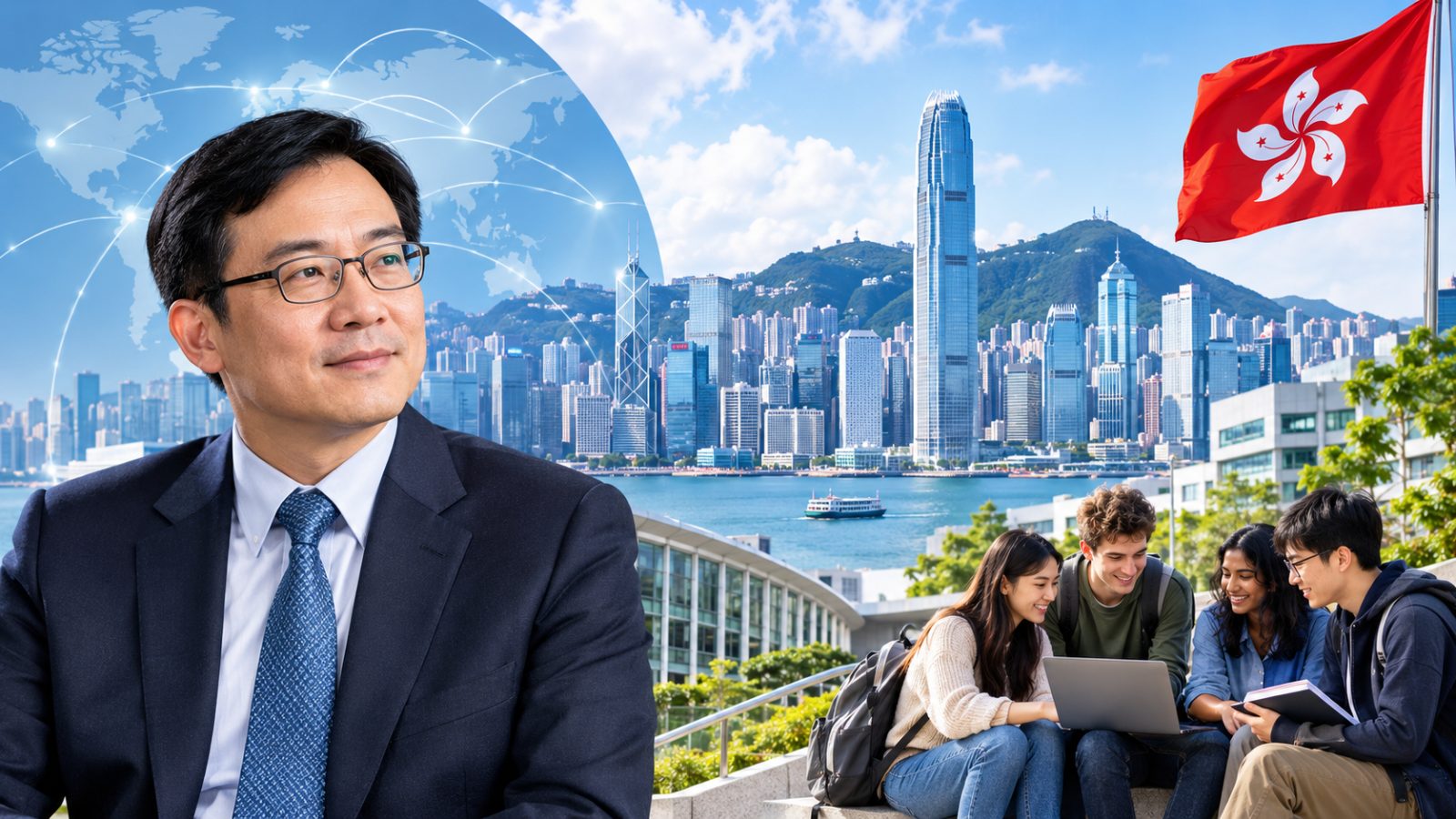
Explore Prof. Xin Wang’s insights on Hong Kong’s rise as a global higher education hub and its growing opportunities.
Ask most people what Hong Kong is known for, and "finance" comes up long before "university destination." That's changing fast. Hong Kong's universities are climbing global rankings, drawing increasingly international cohorts, and actively repositioning the city as a genuine alternative to the US, UK, and Singapore for postgraduate study. To understand what's actually driving this shift, Studyportals spoke with Prof. Xin Wang, Associate Dean (Taught Postgraduate) at HKU Business School, who offered a detailed, on-the-ground account of how Hong Kong is remaking its identity in global education.
From "Finance Hub" to "Education Hub"
According to Prof. Wang, the perception shift has been genuinely rapid. Five years ago, most people's association with Hong Kong began and ended with finance, banking, and trading. Today, he says, students and parents are increasingly using a different phrase entirely: "education hub." At HKU Business School's taught postgraduate programmes, that shift shows up directly in the classroom, where cohorts now blend students from mainland China, across Asia, Europe, the Middle East, and beyond — all arriving because they see Hong Kong as the place to understand both global business and the Chinese market simultaneously.
Prof. Wang points to a broader change in what students and families are actually looking for as a key driver: demand has moved well past traditional business education toward programmes that prepare graduates for a world shaped by technology, data, and AI. At HKU, this priority has been reinforced at the highest levels — university leadership has been explicit about the importance of AI literacy across disciplines, not just within engineering or computer science. HKU Business School's response includes expanding AI-related coursework and integrating technology and analytics more deeply into its curriculum, exemplified by the launch of a new Master of Artificial Intelligence in Business (MAIB) programme.
Debunking the "Hong Kong Is Just for Business" Myth
One assumption Prof. Wang pushes back on directly: that Hong Kong is primarily a destination for business students. He calls this a myth. While business remains a natural strength for the city's universities, he points to genuinely strong programmes across engineering, sciences, law, medicine, and social sciences — noting that Hong Kong's education hub strategy explicitly spans all disciplines, not just business and finance.
What's Driving Hong Kong's Rise in Global Rankings
Hong Kong's improved standing in international rankings isn't accidental, according to Prof. Wang — it reflects a deliberate decision by the city's universities to compete at a genuinely global level rather than just regionally. That's translated into substantial investment in faculty, research, and student experience.
At HKU Business School specifically, Master's programmes spanning Finance, Business Analytics, Economics, Marketing, Accounting, FinTech, AI in Business, and Global Management are taught by internationally trained faculty, with coursework built around real cases drawn from Hong Kong, mainland China, and the wider region.
What Actually Sets Hong Kong Apart from the US, UK, and Singapore
Beyond rankings, Prof. Wang identifies a specific combination of factors that make Hong Kong genuinely competitive with more established study destinations:
- Global academic standards paired with deep Asia-market exposure. Students get internationally benchmarked training while gaining much closer exposure to Asian markets, Chinese business practices, and the Greater Bay Area (GBA) than they would studying in the West.
- Strong, direct industry connections. Master's students regularly work on real company projects and interact with industry leaders as part of their coursework — not as an occasional add-on, but as a consistent feature of the learning experience. This feeds directly into strong employment outcomes in finance, consulting, and technology, both within Hong Kong and across mainland China.
- The IANG visa policy. Hong Kong's Immigration Arrangements for Non-local Graduates (IANG) scheme allows non-local graduates to remain in the city and search for work without needing to secure a job offer first — a meaningful advantage over destinations where post-study work rights are more restrictive or contingent on employer sponsorship.
- A genuinely international classroom. A typical HKU Business Master's cohort brings together students from mainland China, across Asia, and around the world, closely mirroring the kind of international teams graduates will actually work in after finishing their degree.
- Lower overall cost relative to top US programmes. Tuition tends to be lower than comparable elite US business programmes, and total cost is further reduced by shorter programme duration and the absence of the multi-year health insurance requirements common in the US system.
Who's Actually Choosing Hong Kong, and Why
Since 2021, Prof. Wang notes that HKU Business School's taught postgraduate programmes have seen a steady rise in non-local applications and enrolments — and the diversity isn't just numerical. Around 40% to 50% of HKU Business School's students hold bachelor's degrees from overseas institutions, bringing genuinely varied academic backgrounds and perspectives into the classroom. Beyond students from mainland China and Hong Kong itself, the school draws strong cohorts from Southeast Asia, India, Europe, and the Middle East.
Prof. Wang says students frequently cite a specific combination as their reason for choosing Hong Kong: a high-quality, fast-paced, internationally recognized education, paired with a clear, well-structured pathway from the classroom into career opportunities across Asia.
The Role of Global Political and Economic Shifts
Prof. Wang is direct about the fact that Hong Kong's rise isn't happening in a vacuum. Political changes, tightening immigration rules in some Western countries, and broader economic conditions — including currency fluctuations and living costs — are actively pushing students to look at high-quality alternatives within Asia, and Hong Kong has become highly visible in that search.
His framing of the shift is notable: Hong Kong, in his view, is no longer simply the "backup choice" after the US or UK for many prospective students. Increasingly, it's the first choice for students who already know their career ambitions center on Asia.
What Student Life in Hong Kong Actually Looks Like
Asked to describe the lived experience for international students, Prof. Wang characterizes Hong Kong as intense, but in a productive way. A typical week for an international Master's student might include classes in the morning or afternoon, an evening group meeting, a networking event or company talk somewhere in between, and a late dinner with classmates in the city. The pace is fast, but Prof. Wang notes students are navigating it alongside peers who share the same underlying goal: making the most of one or two intensive years, while constantly working across cultures with people from Hong Kong, mainland China, and around the world.
Support Systems for International Students
HKU Business School backs this experience with structured support across three areas, according to Prof. Wang:
- Academic support — a dedicated programme office, accessible faculty, and workshops covering academic writing, group work, and presentations, alongside project-based capstone work
- Professional support — a dedicated career development and training team running CV clinics, mock interviews, and employer events tailored to finance, consulting, tech, and analytics
- Social integration — orientation activities, buddy schemes, student clubs, counselling services, and a Networking Mixer Series designed to help non-local students connect quickly
Prof. Wang notes that students who benefit most tend to be those who engage with these resources early and treat Hong Kong as both a campus and a city worth actively exploring — including growing interest in company visits to technology firms across the Greater Bay Area.
Hong Kong as a Gateway to Asia: What It Means for Graduates
Prof. Wang frames Hong Kong's "gateway to Asia" positioning in three concrete terms:
- Direct access to the Greater Bay Area. A short high-speed train ride or drive connects Hong Kong to Shenzhen, Guangzhou, and other mainland Chinese innovation hubs, giving students easy access to internships, company projects, and immersive experiences. Many HKU Master's students work on live cases with GBA firms — work that frequently leads directly to job offers.
- Built-in regional employer networks. Hong Kong hosts the Asia-Pacific headquarters of numerous global banks, consultancies, tech companies, and multinationals, meaning recruitment activity often starts directly on campus. HKU Business School's careers team actively connects students to these opportunities, including through a flagship Capstone Project that pairs Master's students with organizations to solve real business challenges under academic supervision.
- Flexibility across markets. Graduates often begin their careers in Hong Kong — where English proficiency, international experience, and favorable visa policies for top talent all work in their favor — before moving into roles across mainland China, Southeast Asia, or further afield.
Is Hong Kong's Momentum Sustainable?
Prof. Wang is candid that Hong Kong's current rise is real but not guaranteed to continue indefinitely. He identifies three factors that will determine whether the city becomes a genuine long-term global education hub, rather than a temporary beneficiary of shifting global dynamics:
- Sustaining genuinely world-class academic quality. Rankings help open doors initially, but in his view, it's strong teaching, research, and career outcomes that make students stay and actively recommend Hong Kong to others.
- Remaining open and welcoming. Visa policies, post-study work opportunities, and overall quality of life will continue to shape how Hong Kong compares to competing destinations.
- Deepening the link between universities and the real economy. The more internships, cross-border projects, and clear career pathways students encounter, the more Hong Kong distinguishes itself as a place where students don't just study Asia — they build an actual career there.
Prof. Wang's own assessment is that Hong Kong is not merely a short-term alternative benefiting from other countries' tightening policies. If the city continues investing in quality, openness, and employability, he believes it's genuinely on track to become one of the core hubs in the global higher education system.
What This Means for Prospective Students
Drawing on Prof. Wang's account, a few practical takeaways emerge for students evaluating Hong Kong as a study destination:
- Don't assume Hong Kong only makes sense for business degrees. Strong programmes exist across engineering, science, law, medicine, and social sciences, in line with the city's explicitly multi-disciplinary education hub strategy.
- Weigh the IANG visa policy seriously. The ability to stay and search for work without a pre-secured job offer is a meaningful practical advantage worth factoring into your decision.
- Consider total cost, not just tuition. Shorter programme durations and different insurance requirements can make the real cost gap between Hong Kong and comparable US or UK programmes larger than headline tuition figures suggest.
- Look for programmes with genuine industry integration. Capstone projects, company visits, and direct employer contact during your studies can meaningfully shape your post-graduation outcomes — ask specifically about these when comparing programmes.
- Think regionally, not just locally. If your career ambitions involve mainland China or wider Asia-Pacific markets, Hong Kong's Greater Bay Area access and regional employer networks are a distinctive advantage over studying in the West.
Frequently Asked Questions
Is Hong Kong only a good study destination for business degrees? No. While business is a recognized strength, Hong Kong's universities also offer strong programmes in engineering, sciences, law, medicine, and social sciences, and the city's education hub strategy explicitly covers all disciplines.
What is the IANG visa, and why does it matter for international students? IANG (Immigration Arrangements for Non-local Graduates) allows non-local graduates of Hong Kong universities to remain in the city and look for work without needing a job offer secured in advance — a notable advantage compared to more restrictive post-study work systems elsewhere.
How international are Hong Kong university cohorts? At HKU Business School, roughly 40–50% of students hold bachelor's degrees from overseas institutions, with strong representation from mainland China, Southeast Asia, India, Europe, and the Middle East, alongside local Hong Kong students.
Is Hong Kong cheaper than studying in the US or UK? Often, yes. Tuition tends to be lower than comparable elite US programmes, and shorter programme durations combined with different insurance requirements can further reduce total cost relative to Western alternatives.
What is the Greater Bay Area (GBA), and why does it matter for students in Hong Kong? The Greater Bay Area refers to the cluster of major mainland Chinese cities — including Shenzhen and Guangzhou — located a short train ride from Hong Kong. It gives students direct access to internships, company projects, and career opportunities across one of China's most significant innovation and business regions.
Is Hong Kong's rise as an education hub likely to last? According to Prof. Wang, this depends on Hong Kong sustaining genuinely world-class academic quality, remaining open through favorable visa and quality-of-life conditions, and continuing to strengthen direct links between universities and industry — but his own assessment is that the city is on a genuine long-term trajectory, not simply benefiting from a temporary shift.