
Prof. Nebojša Stoj?i?: How Small Universities Stay Competitive by Going Global
By chidx · Published 4 September 2026
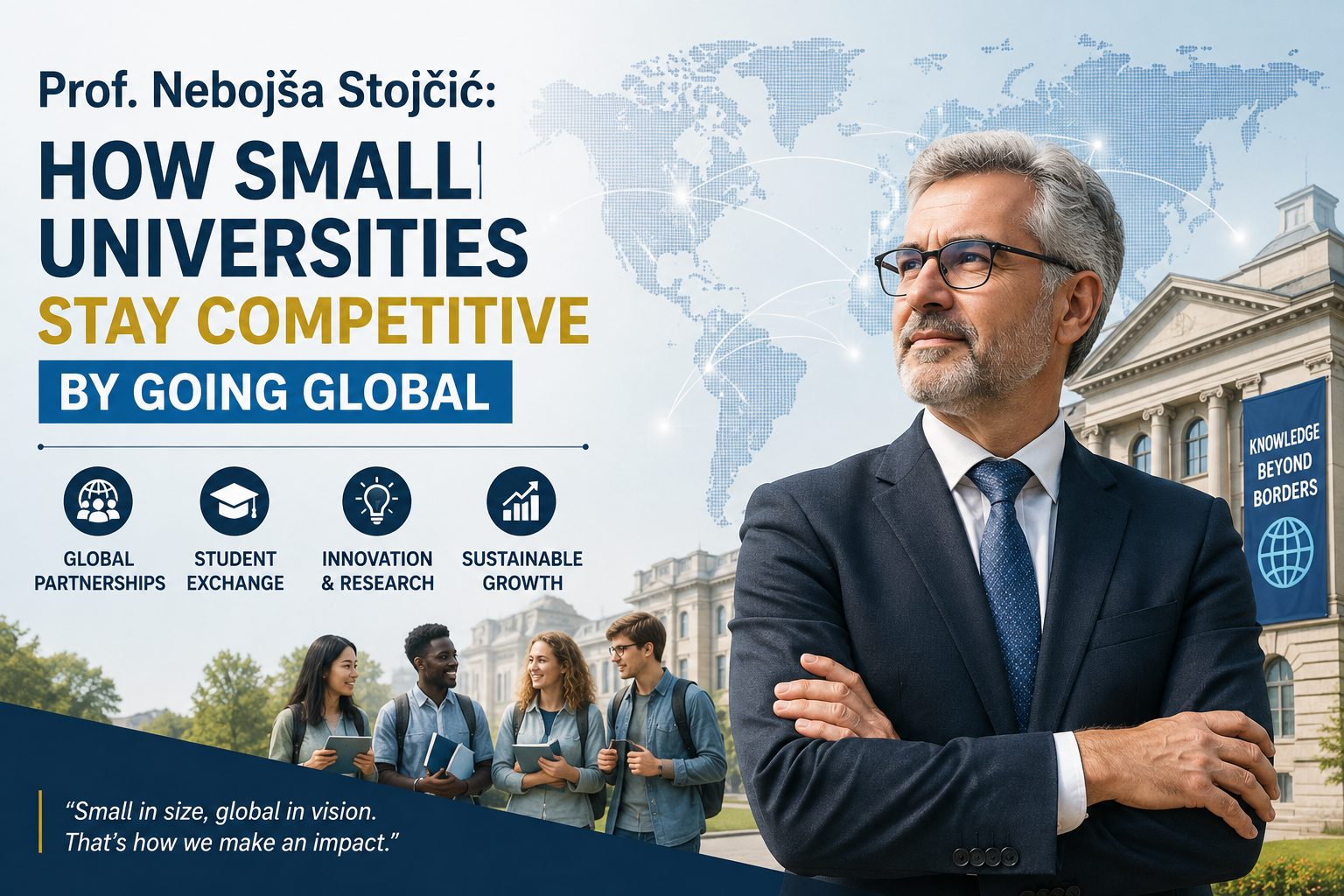
Discover how Prof. Nebojša Stoj?i? says small universities can stay competitive through global partnerships, innovation, and internationalisation.
Not every university competing for international students has a household name, a capital-city campus, or a multi-billion-dollar endowment. Most don't. The real question facing the majority of the world's institutions isn't how to out-rank Oxford or Harvard — it's how a smaller university, in a smaller country, builds something genuinely internationally competitive with the resources it actually has. Prof. Nebojša Stoj?i?, Rector of the University of Dubrovnik in Croatia, has spent much of his academic and administrative career answering exactly that question — and shared his perspective in an interview with Studyportals on how structural constraints can be turned into a deliberate strategy for internationalisation.
Who Is Prof. Nebojša Stoj?i??
Prof. Stoj?i? was elected Rector of the University of Dubrovnik in March 2024, for a term running through September 2028. He's a full professor in the Department of Economics and Business Economics, with a PhD in economics from Staffordshire University in the UK, completed in 2011 with a direct award of the title — placing him among the top 5% of doctoral candidates at the institution. His academic research spans industrial economics, innovation economics, competitiveness, and regional and urban economic processes, with more than 3,000 citations across his published work.
Before becoming Rector, Stoj?i? served as Vice-Rector for Business at the University of Dubrovnik starting in 2017. During that period, the university was repeatedly ranked among the top institutions in Croatia on financial sustainability criteria in international academic excellence rankings. He also personally coordinated the establishment of Croatia's first double degree graduate programmes in economics, built in partnership with the University of Palermo in Italy — a concrete example of the internationalisation strategy he's continued to champion as Rector.
The Central Question: How Do Smaller Universities Stay Competitive?
In his Studyportals interview, Stoj?i? addressed a question that has shaped much of his institutional leadership: how can smaller universities — often located in smaller countries, without the scale, funding, or global brand recognition of major research universities — remain genuinely competitive in an increasingly globalized higher education landscape?
His answer centers on treating structural limitations not as a fixed disadvantage, but as the starting point for a deliberate strategy built around several connected priorities: building a clearer institutional profile, opening more assertively to the world, developing programmes with genuine international relevance, and connecting students directly to frontier research and real societal challenges — rather than trying to compete on scale or reputation alone.
The Double Degree Model as a Practical Example
The double degree partnership Stoj?i? coordinated between the University of Dubrovnik and the University of Palermo offers a concrete illustration of what this strategy looks like in practice. Students in Economics, Business Economics (with a Marketing specialization), and Business Economics (with a Tourism specialization) can spend a semester at the partner institution in Italy and, by completing an agreed set of aligned exams, earn a degree from both universities simultaneously — a qualification designed specifically to give graduates a competitive advantage in the broader European labour market.
This kind of partnership reflects a broader pattern relevant well beyond Dubrovnik: rather than trying to replicate the scale of a large research university, a smaller institution can build focused, high-value international partnerships that give students access to a genuinely dual-market qualification — something a much larger but purely domestic-facing university might not prioritize.
Research Visibility on a Global Stage
Beyond formal degree partnerships, Stoj?i?'s approach to internationalisation extends into research visibility and global engagement. The University of Dubrovnik, under his leadership, has hosted high-profile academic visitors — including a 2025 Nobel Physics laureate recognized for contributions to superconducting quantum processors — and Stoj?i? himself has represented the university at international forums, including delivering a keynote at the ICOBEST 2026 conference in Indonesia on the challenge many emerging economies face in translating existing knowledge, research, and talent into genuine productivity gains and technological upgrading.
Stoj?i?'s research center at the university, CREDO, has also been engaged in contributing expert insight to UNIDO's Industrial Development Report process — a major global report on industrial development that, in its next edition, is set to focus specifically on artificial intelligence as a key driver of future industrial development. This kind of engagement illustrates a core part of the strategy: a smaller university building genuine international research credibility not by trying to out-compete large institutions on volume, but by contributing meaningfully to specific, high-visibility global conversations.
AI, Lifelong Learning, and the Future of Study Programmes
The interview also touched on how broader forces are reshaping what universities — small and large alike — need to offer going forward. Three themes stood out in Stoj?i?'s account:
- AI is reshaping economics as a discipline, not just as a tool used within it — meaning universities need to actively rethink curricula rather than simply add isolated AI-related modules onto existing programmes.
- Lifelong learning is no longer optional. As industries and required skill sets change faster than traditional degree cycles, universities — including smaller, regionally focused ones — need to build genuine pathways for professionals to return and reskill, not just serve traditional-age students on a single, linear path.
- Future study programmes will need to be more interdisciplinary. Rigid single-discipline degree structures increasingly struggle to prepare graduates for problems that don't respect traditional academic boundaries — a shift that arguably gives smaller, more agile institutions a genuine opportunity, since redesigning a compact set of programmes is often more achievable than restructuring a sprawling, large-scale curriculum.
What This Means for Smaller Universities More Broadly
Stoj?i?'s account, grounded in his own experience leading a relatively small, regionally located public university, offers a transferable framework for institutions facing similar structural constraints elsewhere in the world:
- Build a clear, specific institutional profile rather than trying to be broadly competitive on every front. Trying to compete across every discipline and metric that large research universities are judged on is rarely realistic for a smaller institution — a sharper, more defined identity tends to travel further internationally.
- Pursue targeted, high-value international partnerships — like double degree agreements — rather than only broad, loosely defined "internationalisation" initiatives that don't translate into concrete student outcomes.
- Seek out visible participation in global research conversations, even at a smaller scale, rather than assuming visibility requires the resources of a major research university.
- Treat curriculum redesign — around AI, interdisciplinarity, and lifelong learning — as an opportunity smaller institutions may be structurally better positioned to move quickly on, rather than as a burden only larger universities can absorb.
- Connect students directly to real societal and research challenges, using proximity to specific regional industries, challenges, or opportunities as a genuine advantage rather than a limitation.
What This Means for Prospective International Students
For students evaluating smaller, less globally famous universities as part of their study abroad search, Stoj?i?'s account suggests a few practical things worth checking:
- Look for concrete international partnerships, like double degree agreements, rather than just general claims of an "international outlook" — a formal dual-qualification arrangement with a partner university abroad is a tangible, verifiable signal of real internationalisation.
- Check whether the institution is engaged in visible international research activity — participation in major global reports, international conferences, or notable academic visits can indicate a level of research relevance disproportionate to the university's overall size or ranking.
- Consider whether the programme structure reflects current priorities — genuine AI integration, interdisciplinary design, and flexible lifelong-learning pathways are increasingly meaningful signals of a forward-looking institution, regardless of its size or global name recognition.
- Don't equate a smaller or less internationally famous university with lower quality. A focused, well-partnered institution in a specific field can offer genuinely strong, internationally relevant outcomes — sometimes with more direct faculty access and a more tailored experience than a much larger, more anonymous alternative.
Frequently Asked Questions
Who is Prof. Nebojša Stoj?i?? He is the Rector of the University of Dubrovnik, Croatia, serving a term from October 2024 to September 2028. He's a full professor of economics with a PhD from Staffordshire University, UK, and a researcher specializing in innovation and industrial economics.
What is a double degree programme, and why does it matter for smaller universities? A double degree programme allows students to earn qualifications from two partner universities simultaneously, typically by spending part of their studies at each institution. For smaller universities, it's a practical way to offer genuine international value without the resources required to build large-scale international operations independently.
How can a smaller university compete internationally against larger, more famous institutions? According to Stoj?i?'s account, the strategy centers on building a clear, specific institutional profile, pursuing targeted international partnerships, engaging visibly in global research conversations, and redesigning curricula around interdisciplinarity and current priorities like AI — rather than trying to compete broadly on scale or reputation.
Why does AI matter for economics and business programmes specifically? According to Stoj?i?, AI is reshaping economics as a discipline itself, not simply serving as an added tool — meaning universities need to rethink curriculum design more fundamentally rather than layering isolated AI modules onto existing programmes.
Is lifelong learning becoming a standard part of university strategy? According to Stoj?i?, yes — as industries and required skills change faster than traditional degree cycles, universities increasingly need to build genuine pathways for working professionals to return and reskill, rather than serving only traditional-age students on a single linear path.