
How to Take an English Test From Home: A Complete Guide
By chidx · Published 15 September 2026
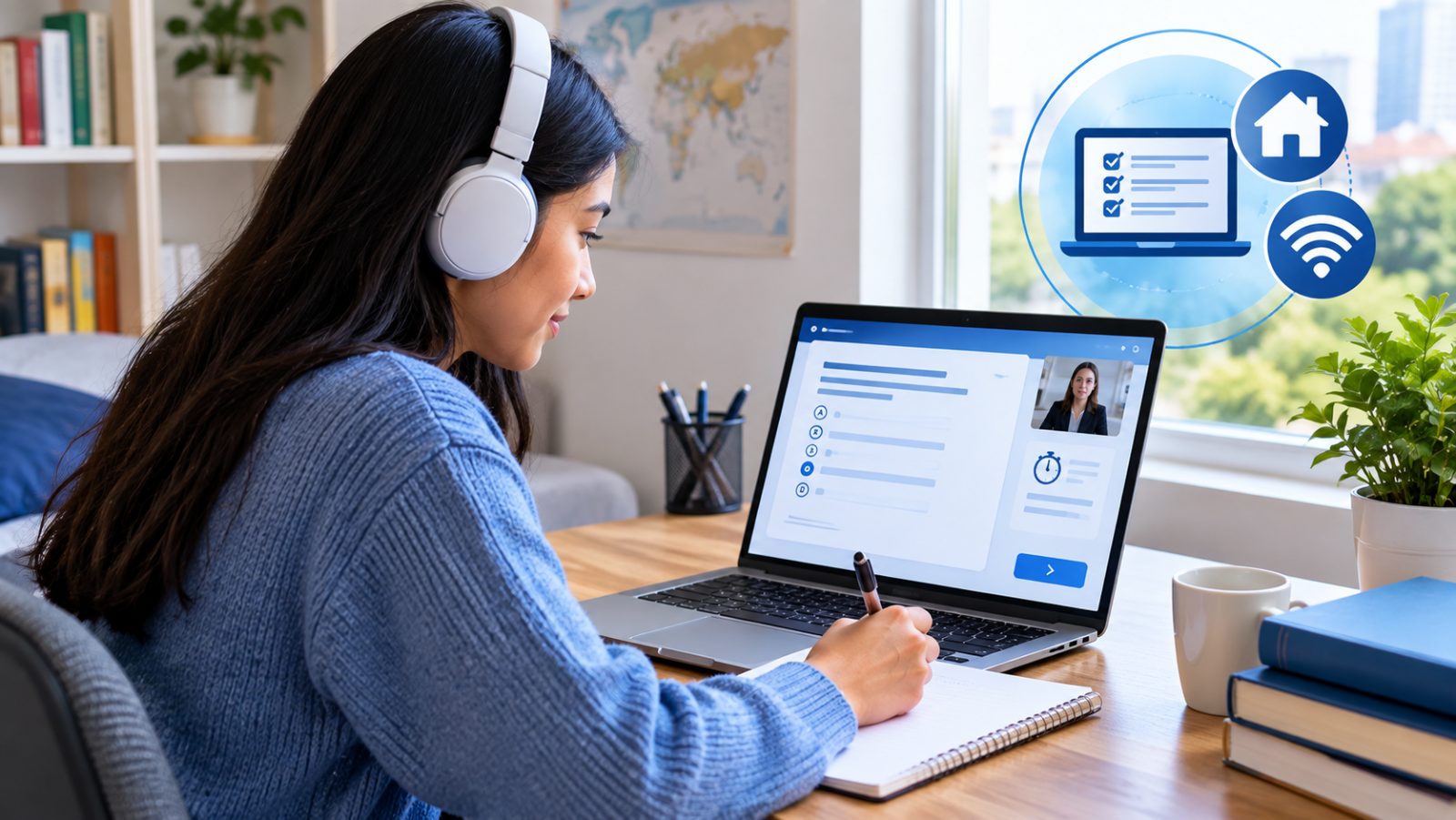
Learn how to take an English test from home, including online options, requirements, setup tips, and how to prepare.
Taking an English proficiency test used to mean booking a seat at a test center, traveling on exam day, and hoping the room was quiet. That's no longer the only option. Tests like the TOEFL iBT Home Edition, Duolingo English Test (DET), IELTS Online/Indicator, and PTE Online now let you sit for a fully proctored, internationally recognized English exam without leaving your house.
This guide walks through which home-based English tests exist, what you need to take one, how the process actually works from booking to results, and how to avoid the mistakes that get sessions flagged or invalidated.
Why Take an English Test From Home?
Home-based testing has grown well beyond its pandemic-era origins into a mainstream option that many universities, employers, and immigration bodies now accept. The main draws are:
- Convenience – no travel, no test-center queues, and in some cases availability almost every day of the week.
- Speed – results often arrive in a few days rather than weeks.
- Cost and access – useful in areas with no nearby test center, or when center slots are fully booked before a deadline.
- Comfort – you test in a familiar environment, at a time that suits you (within the test's scheduling windows).
The trade-off is that you take on responsibility for your equipment, room setup, and internet connection — things a test center normally handles for you. A technical failure or a rule violation can invalidate your session just as surely as a wrong answer.
The Main Home-Based English Tests
TOEFL iBT Home Edition
Run by ETS, this is the identical TOEFL iBT exam — same Reading, Listening, Speaking, and Writing sections, same 0–120 scoring scale, same content pool — just delivered to your own computer instead of a test-center workstation, under live remote proctoring. It's available several days a week, close to 24 hours a day, and most universities treat the score report the same way regardless of whether it was taken at home or in a center. Acceptance for visa and immigration purposes varies by country, so if you need the score for a visa application, confirm eligibility with the relevant authority first.
Duolingo English Test (DET)
The DET is a shorter, adaptive test taken through a dedicated desktop app rather than a browser. It's accepted by thousands of institutions worldwide, including all Ivy League universities, and is popular for its low cost, roughly one-hour length, and fast turnaround. Its setup requirements have gotten stricter in recent updates — expect a mandatory second-camera check using your phone, a 360° room scan, and an ear check before the test even begins. One notable limitation: the DET is generally not accepted as a Secure English Language Test for UK student visas, even though many UK universities accept it for admissions decisions — so UK-bound applicants often still need IELTS or another approved test for the visa itself.
IELTS Online and IELTS Indicator
IELTS now offers computer-delivered and at-home options in many regions. The IELTS Indicator test was originally introduced as an interim, at-home alternative, and it follows the same format and difficulty as IELTS Academic, with results in about seven days. Importantly, IELTS Indicator is not a universal substitute for standard IELTS — some institutions and most immigration bodies (including in Canada, Australia, and New Zealand) do not accept it, so always confirm acceptance with your specific university or authority before relying on it.
PTE Online
Pearson's PTE Online mirrors the test-center version of PTE Academic, with remote proctoring and computer-based, AI-scored sections. It's a solid option where fast, machine-scored results matter, though — as with the others — acceptance depends on the receiving institution.
What You'll Need to Take an English Test at Home
Requirements differ slightly by test provider, but the essentials are consistent across all of them:
- A qualifying computer – typically Windows 10/11 or macOS running a recent version; tablets and Chromebooks are usually not allowed.
- A working webcam and microphone – built-in or external, used for identity verification and live proctoring.
- A stable, wired-if-possible internet connection – most providers specify a minimum upload/download speed.
- A private, quiet room – no other people, no interruptions, and a desk cleared of notebooks, extra devices, and phones (except where a phone is required as a second camera).
- Valid photo ID – a passport or government ID matching your registration details.
- Appropriate lighting – light in front of you rather than behind you, so the proctor can clearly see your face.
- A second device for some tests – the DET, for example, requires a smartphone or tablet positioned to record the room and your screen area throughout the test.
Step-by-Step: How to Book and Take a Home English Test
- Choose the right test for your goal. Check the specific score requirement and accepted tests listed by the university, employer, or immigration authority you're applying to — don't assume one test is interchangeable with another.
- Create an account and register. Register directly through the official provider (ETS for TOEFL, Duolingo, the IELTS website, or Pearson for PTE). Avoid third-party sites for registration.
- Run the system check well before test day. Every provider offers an equipment/compatibility check. Run it at least a day in advance so you have time to fix problems.
- Prepare your room. Clear your desk, inform housemates or family you cannot be interrupted, and set up lighting so your face is clearly visible on camera.
- Check in on test day. This usually involves a photo ID scan, a webcam photo, and a room scan (sometimes a full 360° scan using your webcam or a second device).
- Complete the test under live or recorded proctoring. Stay in view of the camera, don't look away from the screen for long stretches, and don't leave the room until instructed.
- Wait for scoring. Turnaround ranges from about 48 hours (DET) to roughly 4–8 days (TOEFL, IELTS, PTE), depending on the test.
- Send your scores. Most providers let you send official score reports to institutions directly and for free from your account.
Common Mistakes That Get Sessions Flagged or Invalidated
Home tests are monitored closely precisely because there's no in-person invigilator standing over your shoulder. The most common violations reported across providers include:
- Someone else entering the room or speaking to you during the test.
- Frequent gaze diversion — looking away from the screen too often, even just to think.
- Unauthorized items on the desk, such as notes, extra devices, or a smartwatch.
- Background software running that isn't permitted, like VPNs or remote-access tools.
- Poor camera positioning that fails to show your face or the full room clearly.
- Backlighting that silhouettes your face and fails identity verification.
Avoiding these is mostly a matter of preparation: clear your space, test your equipment the day before, and follow the check-in instructions exactly as given.
Tips to Do Your Best on Test Day
- Practice under real conditions. Use each provider's official practice tests to get used to the interface and timing — a home-based test still has the same academic difficulty as its test-center counterpart.
- Test your internet at the same time of day you're scheduled to test, since household usage patterns can affect speed.
- Have a backup plan for internet or power interruptions — know your provider's policy on rescheduling if a technical issue occurs.
- Sleep and eat normally beforehand. A test taken from home is still a multi-hour cognitive task; treat it the same as an in-person exam.
- Read the specific rules for your test rather than relying on general advice, since setup requirements (like the DET's second-camera rule) change and vary by provider.
Which Test Should You Choose?
There's no universally "best" option — it depends entirely on what the receiving institution or authority will accept:
- If a specific visa or immigration process requires a named test (often IELTS or TOEFL), take that one, and check whether the at-home version is accepted for that purpose.
- If you need a fast, low-cost option for university admissions and your target schools list it as accepted, the Duolingo English Test is often the most convenient.
- If your program specifically lists PTE as accepted, PTE Online offers a comparable at-home path with quick, automated scoring.
Whichever test you choose, the golden rule is the same: confirm acceptance with your specific institution or authority before you register, since policies differ by country, program, and purpose.
Final Thoughts
Taking an English test from home has gone from a stopgap measure to a standard, well-supported option offered by every major test provider. The exams themselves haven't gotten easier — they carry the same content and scoring as their in-person versions — but the logistics have gotten dramatically simpler, provided you prepare your equipment, room, and documentation properly. Check the acceptance requirements for your specific goal, run your system checks early, and treat test day with the same seriousness you would give an in-person exam.