
How to Improve Your Grades: A Practical Guide for School and College
By chidx · Published 31 August 2026
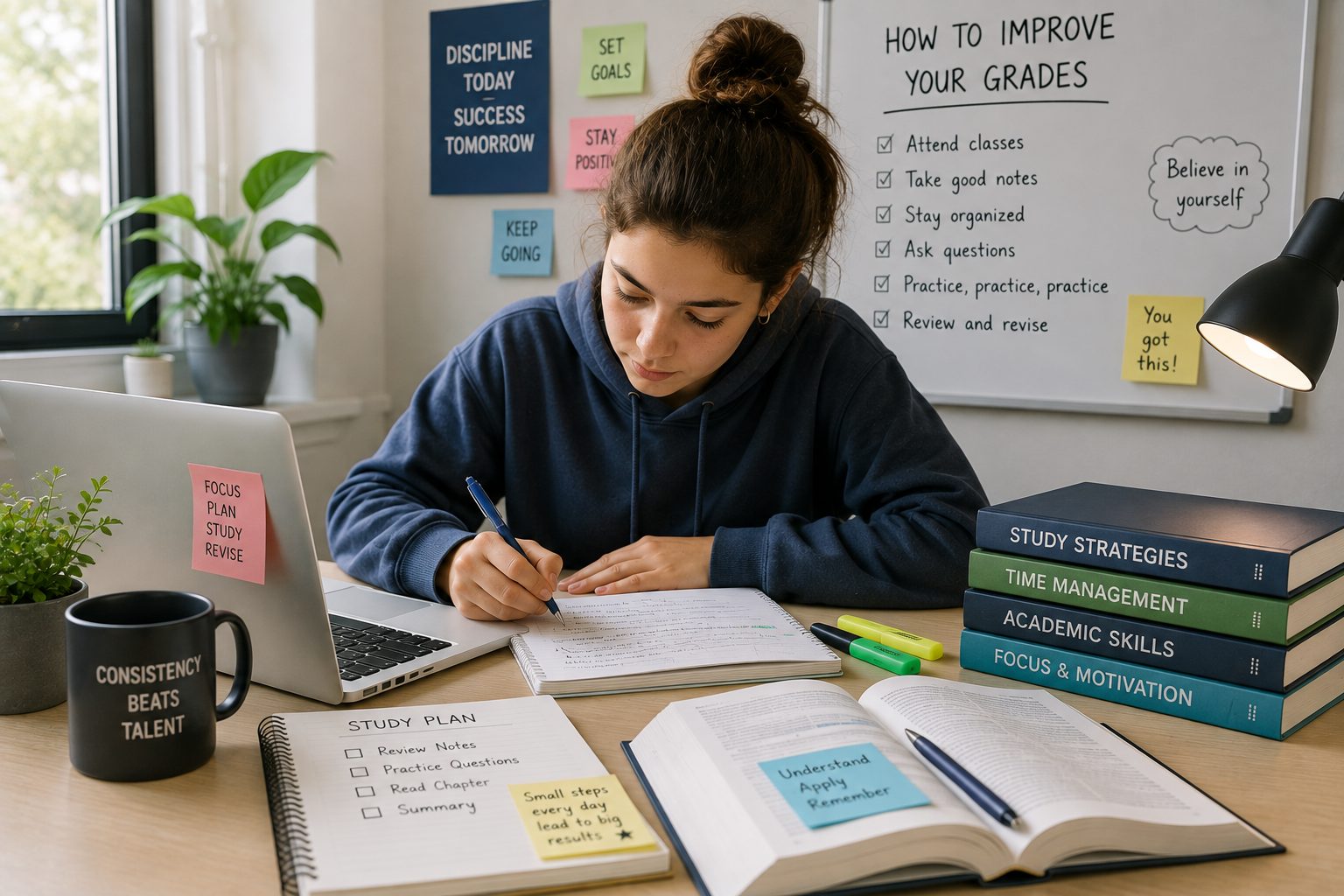
Learn how to improve your grades with practical study tips, better time management, effective revision, and proven strategies.
Most students who want better grades reach for the same first instinct: study more. More hours, more re-reading, more caffeine. The problem is that how you study usually matters more than how much — and a lot of common study habits feel productive without actually building lasting understanding. Here's a genuinely practical, evidence-based guide to improving your grades, whether you're in high school or university.
Start With an Honest Diagnosis
Before changing anything, figure out where your grades are actually breaking down. "I need to study more" is rarely the whole story. Common patterns worth checking honestly:
- Understanding gap — you follow along in class but can't apply the material independently on assignments or exams
- Retention gap — you understand material when you study it, but it doesn't stick by test day
- Execution gap — you know the material but lose points on exam technique, time management, or careless errors
- Organization gap — grades suffer from missed deadlines, disorganized notes, or simply losing track of what's due when
- Engagement gap — you're not retaining material because you're not genuinely engaging with it, often due to burnout, disinterest, or being overextended elsewhere
Different problems need different fixes. A student with an execution gap needs better exam strategy, not more content review. A student with a retention gap needs spaced repetition, not longer single study sessions. Spend real time figuring out which category (or combination) actually describes your situation before changing your approach.
The Study Techniques That Actually Work
Decades of cognitive science research point consistently toward a small set of techniques that outperform the study habits most students default to.
Active Recall (Not Re-Reading)
The single most well-supported finding in learning research: testing yourself on material is far more effective than re-reading it. Re-reading notes or a textbook feels productive because the material feels familiar — but familiarity is not the same as being able to recall and apply it under exam conditions.
How to actually do it:
- Close your notes and try to write down everything you remember about a topic from memory, then check what you missed
- Use flashcards genuinely — testing yourself on the answer, not just flipping through and nodding along
- Turn your notes into practice questions and answer them without looking
- After solving a problem set, try re-solving it a few days later without referring back to your original solution
Spaced Repetition (Not Cramming)
Studying the same material in short sessions spread across multiple days consistently produces significantly better long-term retention than compressing the same total study time into one or two long sessions right before a test.
How to actually do it:
- Review new material within 24 hours of first learning it, then again after a few days, then again after a week or two
- Use a spaced repetition tool (like Anki or similar flashcard apps) that automatically schedules reviews based on how well you know each item
- Build a rolling review habit — spend the first 10–15 minutes of each study session briefly reviewing material from previous weeks before moving to new content
Interleaving (Mixing Topics, Not Blocking)
Rather than practicing one type of problem repeatedly before moving to the next (called "blocked practice"), mixing different types of problems or topics within a single study session — called interleaving — has been shown to improve your ability to actually distinguish between problem types and apply the right approach, which is exactly what exams require.
How to actually do it:
- When doing practice problems, mix problem types rather than doing 20 of the same kind in a row
- When reviewing multiple subjects or chapters, rotate between them within a study session rather than exhausting one topic before starting the next
The Feynman Technique (Explaining It Simply)
Try explaining a concept in plain language, as if teaching it to someone with no background in the subject. Wherever you get stuck, stumble, or resort to jargon without real understanding, that's exactly where your knowledge gap actually is.
How to actually do it:
- Pick a concept and write or say an explanation of it in the simplest language you can, avoiding technical terms
- When you hit a point where you can't explain something simply, go back to your source material specifically on that point
- Repeat until you can explain the whole concept cleanly, without gaps
Building a Study System, Not Just Study Sessions
Isolated study techniques help, but consistent grade improvement usually comes from a broader system.
Time Management That Actually Holds Up
- Break large tasks into smaller milestones early, rather than treating a big assignment or exam as one looming block until the final days.
- Use a planner or digital calendar for every deadline — not just major exams, but smaller assignments, readings, and problem sets that quietly add up.
- Protect specific study blocks in your schedule, treating them with the same seriousness as a class or appointment, rather than leaving studying to "whenever there's time."
- Build in buffer time before deadlines, since unexpected setbacks (illness, technical issues, other coursework colliding) are common enough that a zero-margin schedule tends to collapse under real-world friction.
Note-Taking That Actually Helps Later
- Rewrite or reorganize notes shortly after class, while the material is still fresh — this is itself a form of active recall and tends to surface gaps in understanding early, when they're easier to fix.
- Use a structured format (like the Cornell method, or simple heading-based organization) that makes your notes genuinely reviewable later, rather than a stream-of-consciousness transcript of what was said.
- Note questions, not just answers — if something confuses you during a lecture or reading, write the question down explicitly rather than letting it quietly slide past, so you can follow up on it later.
Using Office Hours and Extra Help Proactively
Office hours, tutoring centers, and study groups are consistently underused resources, particularly once material starts to feel genuinely confusing rather than just mildly unclear. Going early — before you're desperately behind — tends to be far more useful than waiting until right before an exam, both because you'll get more focused help and because instructors and tutors generally respond well to students who show up prepared with specific questions.
Exam-Specific Strategies
Some grade problems aren't about understanding the material at all — they're about how you perform under exam conditions.
- Read the entire exam before starting, to budget your time realistically across sections and avoid running out of time on later questions worth significant points.
- Answer what you know first, then return to harder questions — this avoids losing time (and confidence) getting stuck early on a difficult question while easier points sit unanswered elsewhere.
- Practice under realistic conditions — timed, without notes, in an environment similar to your actual exam setting — rather than only ever reviewing material in a low-pressure, open-book context.
- Review your own past mistakes systematically. After a graded assignment or exam comes back, actually go through what you got wrong and understand why — not just to feel bad about the grade, but because your own past mistakes are often the single best predictor of what to focus on next.
The Habits That Quietly Undermine Grades
A few patterns are worth checking honestly, since they're easy to overlook but have an outsized effect on academic performance:
- Chronic sleep deprivation. Sleep plays a critical role in memory consolidation — poor sleep habits, especially during exam periods, directly undermine the very retention you're trying to build through studying.
- Multitasking while studying. Studying with constant phone notifications, background video, or frequent task-switching measurably reduces both the efficiency and depth of learning, even when it doesn't feel that disruptive in the moment.
- Passive "studying" that isn't really studying. Highlighting text, re-reading slides, or watching a lecture recording passively can feel productive without actually building the kind of retrievable understanding that shows up on exams — pair these activities with active recall to make them genuinely effective.
- Ignoring feedback on graded work. Skimming a grade and moving on, without actually reviewing what went wrong, means repeating the same mistakes across multiple assignments or exams.
When Grades Aren't Improving Despite Real Effort
If you're putting in genuine, sustained effort and still not seeing improvement, it's worth considering a few possibilities beyond "study harder":
- Talk to your teacher or professor directly about specifically where you're losing points — sometimes the gap is narrower and more fixable than it feels from the outside (a specific misunderstanding, a particular exam format you struggle with, a gap in a prerequisite skill).
- Consider whether workload or life circumstances outside academics are genuinely limiting your available study time and energy — this isn't a moral failing, but an honest constraint worth acknowledging and planning around realistically, rather than treating unlimited effort as the only lever available.
- Rule out an undiagnosed learning difference. If you consistently struggle with specific, recurring patterns — such as reading comprehension, processing speed, or organization — despite genuinely strong effort, it may be worth discussing with a school counselor, disability services office, or healthcare provider, since accommodations or a different approach entirely can make a meaningful difference.
- Check in on your overall wellbeing. Chronic stress, anxiety, or burnout can significantly affect concentration and memory, independent of how hard you're trying — if this feels like it might be part of the picture, it's worth talking to someone (a school counselor, trusted adult, or healthcare provider) rather than assuming the only fix is more study time.
A Realistic Weekly Rhythm
Rather than treating studying as something that happens in occasional intense bursts, a more sustainable structure tends to look like:
- Right after each class: Briefly review and reorganize notes while the material is fresh (10–15 minutes)
- A few times a week: Dedicated active recall sessions on recent material — flashcards, self-testing, practice problems
- Weekly: A broader review session that revisits older material using spaced repetition, not just the most recent content
- Before assignments and exams: Focused practice under realistic, timed conditions, plus a review of any previous graded feedback on similar material
- Ongoing: Protecting sleep, especially during exam periods, and proactively using office hours or tutoring when something isn't clicking — rather than waiting until you're significantly behind
Frequently Asked Questions
What's the single most effective study technique? Active recall — testing yourself on material rather than passively re-reading it — is consistently the most well-supported technique in learning research, though combining it with spaced repetition (reviewing material across multiple sessions over time) tends to produce the strongest results.
Is cramming ever effective? Cramming can help with short-term recognition of material, but it consistently produces worse long-term retention than studying the same material across multiple spaced sessions — and research suggests all-nighters specifically tend to impair the memory consolidation and cognitive performance needed to perform well on exams.
How many hours should I study per day? There's no universal number — focused, active study time tends to matter more than raw hours. A shorter session using active recall and spaced repetition often outperforms a much longer session of passive re-reading.
What should I do if I'm studying hard but my grades aren't improving? Start by identifying which specific gap is limiting you — understanding, retention, exam execution, or organization — since the right fix depends on which one applies. If the gap persists despite real effort, talking to your teacher, checking in on your overall wellbeing, and considering whether an underlying learning difference might be involved are all worth exploring.
Does taking notes by hand work better than typing? Research findings are mixed and depend on the individual and context, but handwriting notes has been associated with better conceptual understanding in some studies, possibly because it naturally encourages summarizing in your own words rather than transcribing verbatim — though what matters most is actively engaging with the material during note-taking, regardless of method.