
How KU Leuven Prepares Flexible Business Leaders for an Uncertain Future
By chidx · Published 29 August 2026
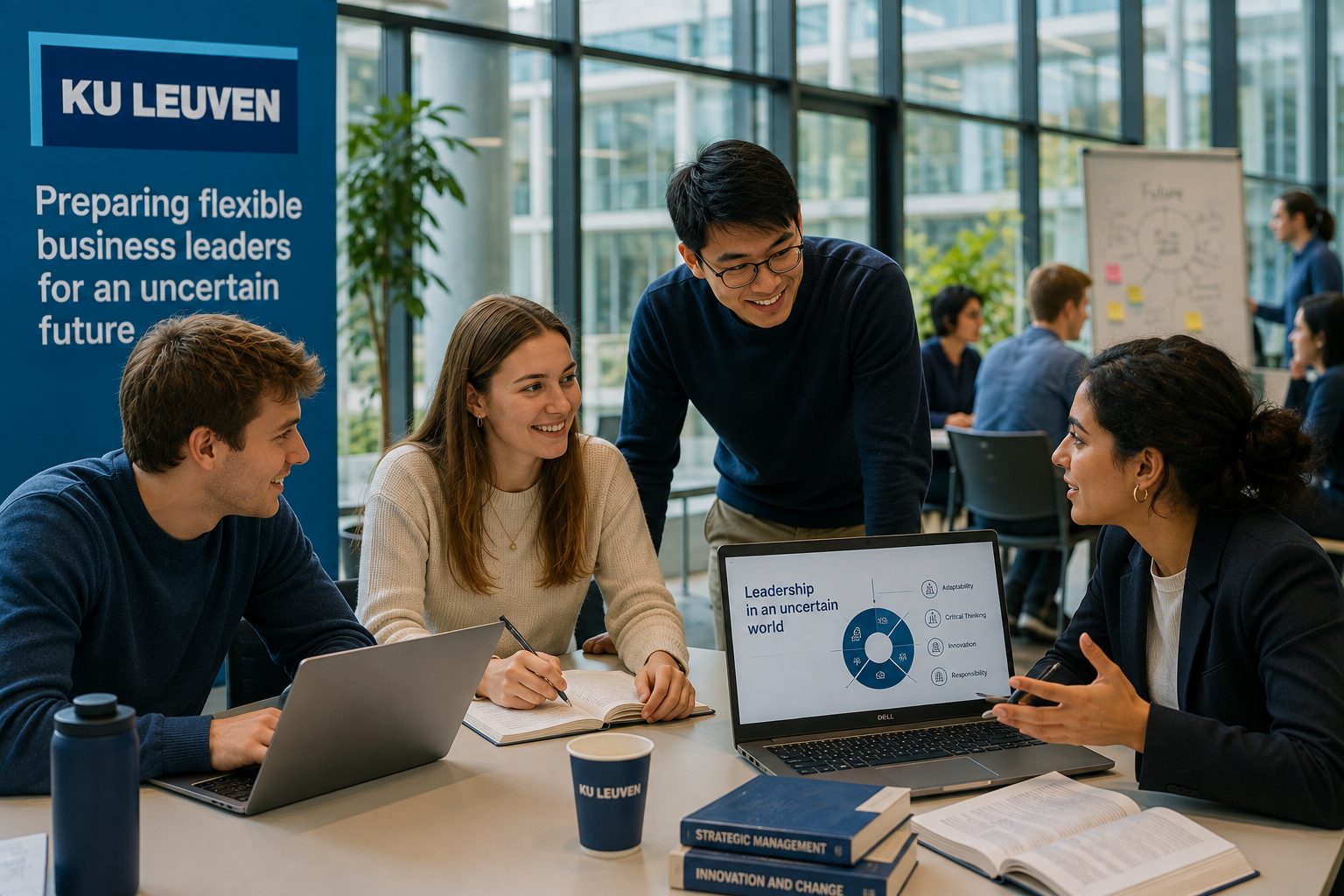
Discover how KU Leuven prepares flexible business leaders with innovative programs, practical skills, and global perspectives.
Business education has a familiar problem: the world changes faster than most curricula do. A program built around a fixed set of concentrations risks training leaders for a business landscape that no longer exists by the time they graduate. KU Leuven's Faculty of Economics and Business (FEB) has built its flagship MBA around a different premise — that the most valuable thing a business leader can develop isn't mastery of one function, but the range and adaptability to move across several. This guide looks at how the program is structured, what makes its approach to flexibility distinctive, and who it's actually built for.
Key Takeaways
- KU Leuven's MBA is a one-year, English-taught Master of Science in Business Administration, combining academic rigour with a practical, managerial focus.
- The program offers 16 specialisation tracks across two campuses — Brussels and Antwerp — a notably wider range than most MBA programs, which typically funnel students into two or three broad concentrations.
- The curriculum is structured across four modules totalling 60 ECTS credits within a single academic year, balancing breadth, depth, and research capability.
- Responsibility and sustainability are embedded directly into the core curriculum, not offered as optional add-ons — reflecting a deliberate stance on what "future-ready" leadership actually requires.
- Flexible elective design lets students deepen their chosen track, branch into a second discipline, or gain applied experience through internships and business projects.
- The two campus locations offer distinct strategic advantages: Brussels for proximity to EU institutions, and Antwerp for access to Europe's second-largest port and international trade networks.
Why "Flexibility" Is the Right Framing for Business Education Right Now
The case for flexible, broadly-capable leadership isn't abstract. Businesses today face overlapping, fast-moving pressures — AI-driven disruption, shifting global trade patterns, evolving sustainability regulation, and increasingly unpredictable macroeconomic conditions — that rarely respect the boundaries of a single business function. A finance leader who understands only finance, or a marketing leader with no fluency in data or operations, is increasingly at a disadvantage compared to leaders who can move across disciplines fluidly.
KU Leuven's structural response to this is straightforward: rather than asking students to specialise narrowly and hope that specialisation remains relevant, the program is built to develop specialists who can also think broadly — deep enough in one area to lead credibly, but versatile enough to adapt when the ground shifts underneath a role, an industry, or an entire function.
Inside the Program Structure
One Year, Four Modules, 60 ECTS
The KU Leuven MBA compresses a genuinely comprehensive business education into a single academic year, organized across four distinct modules totalling 60 ECTS credits. This structure is deliberately designed to balance three things that often compete for space in MBA curricula: breadth (exposure across core business disciplines), depth (real specialisation in a chosen track), and research capability (the analytical rigor to evaluate evidence and make sound strategic judgments, not just follow established playbooks).
16 Specialisation Tracks — An Unusually Wide Net
Where many MBA programs limit students to two or three broad concentrations — commonly variations on finance, marketing, and general management — KU Leuven offers 16 specialisation tracks spread across its Brussels and Antwerp campuses. This breadth reflects a specific philosophy: that the "modern business world demands specialists who can also think broadly," rather than generalists with no real depth anywhere, or specialists boxed into a single narrow lane.
Practically, this wide track selection means students can align their MBA more precisely with a specific career direction — whether that's a functional specialisation (finance, marketing, strategy), a sector-specific track, or an emerging discipline shaped by digital transformation — rather than settling for the closest approximation available in a more limited program structure.
Flexible Electives: Deepen, Broaden, or Apply
Beyond the core track selection, the program's elective design gives students three distinct paths to shape their own MBA experience:
- Deepen your track — building further expertise within your chosen specialisation
- Broaden with another discipline — picking up meaningful exposure to a second business function, reinforcing the program's cross-functional philosophy
- Gain hands-on experience — through internships and business projects that translate classroom learning into applied, real-world practice
This structure means no two students necessarily graduate with an identical experience — the flexible design lets each MBA candidate calibrate their own balance between specialisation and range, based on their specific career goals.
Two Campuses, Two Strategic Advantages
KU Leuven's MBA is delivered across two Belgian cities, each offering a genuinely distinct professional context rather than functioning as interchangeable locations:
- Brussels places students close to EU institutions, offering direct proximity to European policy-making, regulatory affairs, and the dense network of international organizations headquartered in the city — valuable for students oriented toward policy, public affairs, or EU-facing business roles.
- Antwerp offers access to Europe's second-largest port and its associated international trade networks, a natural fit for students interested in logistics, supply chain, international trade, or industries connected to global shipping and commerce.
This dual-campus structure lets the program offer geographically grounded professional exposure that a single-city program couldn't replicate as effectively.
Responsibility and Sustainability, Built In — Not Bolted On
One of the more distinctive aspects of KU Leuven's approach is where sustainability and responsible leadership sit in the curriculum: woven into the core, rather than offered as an elective module for students who happen to be interested in the topic. This reflects a broader shift in how leading business schools are treating sustainability — not as a specialised concern for a subset of future ESG professionals, but as a baseline competency every business leader needs, regardless of which function or industry they ultimately work in.
For an MBA explicitly oriented around producing leaders equipped for an uncertain future, this design choice makes sense: regulatory, investor, and stakeholder expectations around sustainability continue to expand across nearly every industry, meaning leaders without fluency in this area are increasingly working with an incomplete toolkit, regardless of their functional specialisation.
Who Graduates Are Prepared For
The program is designed to prepare graduates for coordinating and executive functions across a genuinely diverse range of sectors — not a narrow band of traditional corporate roles. This includes:
- Multinational corporations, where cross-functional fluency and international business exposure are directly relevant
- Social enterprises, reflecting the program's embedded emphasis on responsibility and impact
- EU institutions, particularly for graduates based at or drawn to the Brussels campus
This range is a direct product of the program's design philosophy — a curriculum built around adaptability naturally produces graduates suited to a wider range of organizational contexts than one built around a single narrow career track.
Admissions at a Glance
For prospective applicants, the KU Leuven MBA (Business Administration track) generally requires:
- A bachelor's degree from an accredited institution
- English proficiency evidence, typically a minimum IELTS score of 7.0 overall or a minimum TOEFL score of 94 (note: TOEFL scoring transitioned to a new 1–6 scale in January 2026 — confirm with KU Leuven directly which scale your required score refers to)
- An application fee (historically around €90)
- Standard supporting documentation: transcripts, a CV, and a statement of purpose
Additional costs to budget for beyond tuition can include certified language test fees (roughly €120–300), document translation costs (averaging around €20 per page), and standardized test fees such as the GRE or GMAT where required (roughly €60–300). Given that fees, deadlines, and exact score requirements are updated periodically, always confirm current admissions details directly on KU Leuven's official program pages before applying.
Is This Program the Right Fit for You?
KU Leuven's MBA is likely to be a strong fit for candidates who:
- Want genuine depth in a specific business discipline, but are wary of programs that force an early, narrow commitment with little room to explore adjacent areas
- Are drawn to Europe's business and policy landscape specifically, rather than a program with a purely domestic or US-centric orientation
- Care about sustainability and responsible leadership as a core part of their business education, not an optional add-on
- Want to complete a rigorous MBA in a compact one-year timeframe, rather than the more common two-year format
- Value applied, hands-on learning — internships and business projects — as part of their MBA experience, not just classroom instruction
It may be a less natural fit for candidates seeking a longer, more extended MBA format with a slower pace, or those specifically prioritizing a large US-based alumni network over a strong European and EU-institutional orientation.
Frequently Asked Questions
How long is the KU Leuven MBA program? It's a one-year, English-taught program, structured across four modules totalling 60 ECTS credits.
How many specialisation tracks does KU Leuven's MBA offer? 16 specialisation tracks, spread across the Brussels and Antwerp campuses — a notably wider selection than the two or three broad concentrations typical of many MBA programs.
Where is the KU Leuven MBA taught? Across two campuses in Belgium: Brussels, which offers proximity to EU institutions, and Antwerp, which offers access to Europe's second-largest port and international trade networks.
Does the KU Leuven MBA include sustainability training? Yes — responsibility and sustainability are built directly into the core curriculum rather than offered as optional electives, reflecting the program's broader approach to future-ready leadership.
What English test scores does KU Leuven's MBA require? Historically, a minimum IELTS score of 7.0 overall or a minimum TOEFL score of 94, though exact requirements and the specific TOEFL scale referenced should be confirmed directly with KU Leuven given recent changes to TOEFL's scoring system.
What career paths does the KU Leuven MBA prepare graduates for? Coordinating and executive roles across a broad range of sectors, including multinational corporations, social enterprises, and EU institutions — reflecting the program's cross-functional, adaptability-focused design.