
College Application Resume: A Complete Guide to Writing Yours
By chidx · Published 29 August 2026
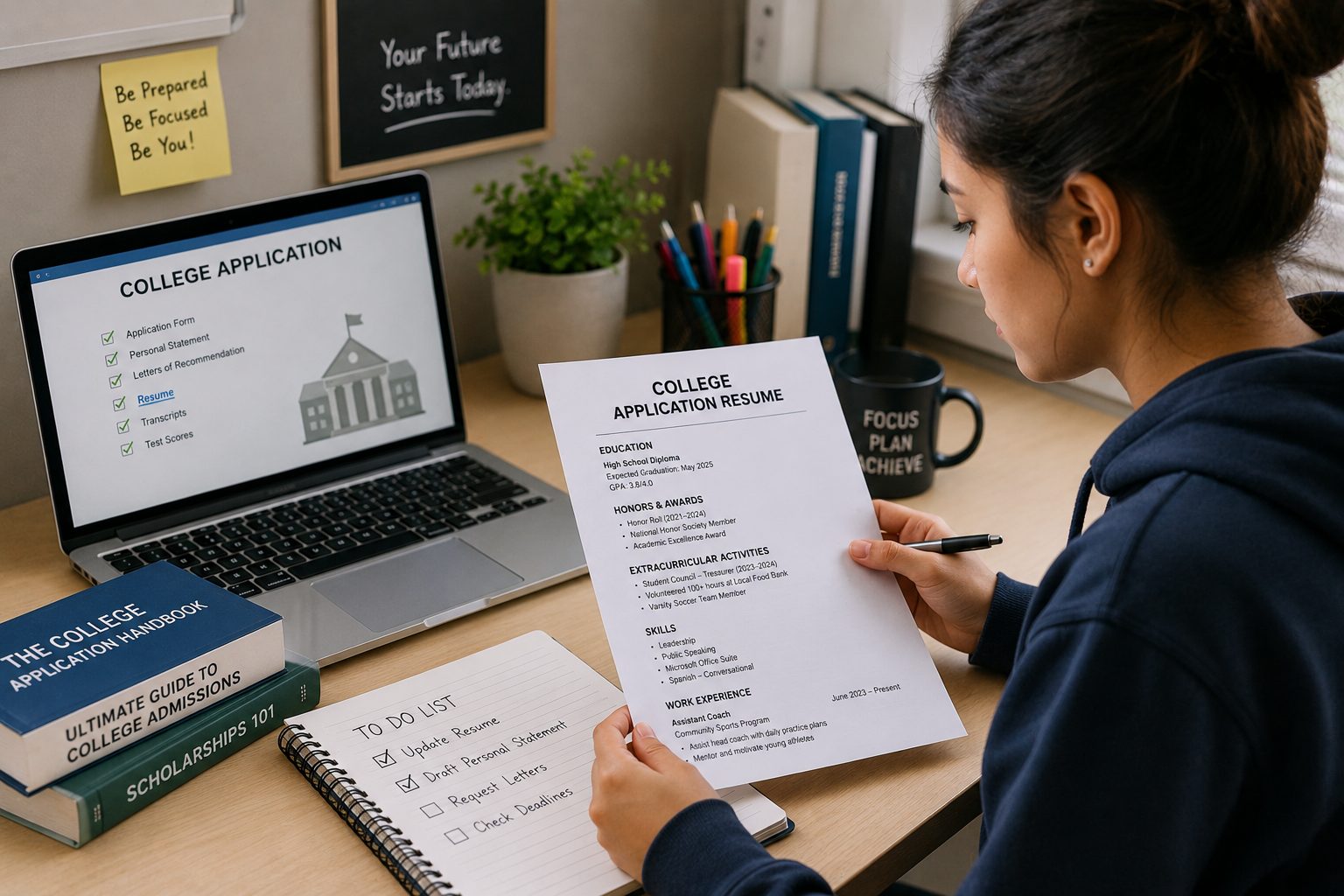
Learn how to write a strong college application resume with key sections, formatting tips, examples, and common mistakes.
You open a blank document, ready to write your college application resume, and then — nothing. It's a common moment of panic for high school seniors: how do you build a resume when you've never had a "real" job? The good news is that a college application resume isn't measured against a professional one. Admissions officers aren't expecting work history — they're looking for a clear, honest picture of who you are, what you've done since ninth grade, and where your energy and curiosity have gone. This guide walks through exactly what to include, how to format it, and how to avoid the mistakes that make even strong resumes fall flat.
Key Takeaways
- A college application resume doesn't require work experience — the functional/skills-based format is built specifically for students who don't have a traditional job history.
- Keep it to one page. Admissions officers skim quickly, and a longer resume dilutes rather than strengthens your application.
- Focus on 3–5 major activities, not an exhaustive list of everything you've ever done — depth and specificity beat volume.
- The most common weakness in student resumes is describing what you were rather than what you did — write about impact and action, not just titles or membership.
- Most college applications, including the Common App, don't require a resume (and some explicitly don't accept one) — but submitting one, where allowed, can add valuable depth beyond what the Activities section captures.
- Only include activities and achievements from ninth grade onward — colleges are focused on your high school years, not middle school.
- Save and submit as a PDF to protect your formatting across every device and screen.
Do You Actually Need a College Application Resume?
Before you spend hours building one, it's worth checking whether your target schools actually want it. The honest answer is: it depends entirely on the individual college.
- Check each university's admissions page, or look inside the Common App portal itself, to see whether a given school includes a place to upload a supplemental resume.
- Some schools explicitly ban resumes as part of the application, in which case submitting one anyway won't help — and could even work against you if it violates stated guidelines.
- The Common App's Activities section is required for everyone, but it's tightly limited in space — closer to a summary than a full picture. A resume gives you room to elaborate where the Activities section can't.
A resume is particularly worth submitting, where allowed, if:
- You have significant achievements that don't fit neatly into the Common App's structured fields — major awards, leadership roles, or long-term commitments that deserve more explanation.
- You've had unique experiences — international volunteering, an independent research project, a personal venture or business, or something else that benefits from added context.
- You're applying to highly competitive programs — dual-degree tracks, honors colleges, or specialized programs — where an extra, well-crafted document can help you stand out among similarly qualified applicants.
Even if you ultimately don't submit a formal resume, building one is still useful groundwork — it becomes a reference document you can pull from when writing essays, filling out other application fields, or applying for scholarships and internships later.
What to Include in a College Application Resume
1. Contact Information
Keep this simple and professional: your full name, address (or just city/state), phone number, and a professional email address — ideally something based on your actual name rather than an old, informal email handle.
2. Education
List your high school, expected graduation date, GPA (if strong and if your school reports it), and any standardized test scores you're comfortable including. If you're applying to a specific program or major, this section can briefly note relevant coursework.
3. Extracurricular Activities
This is usually the heart of a student resume. For each activity, include:
- The organization or activity name
- Your role or title
- Dates or years of involvement
- A brief, specific description of what you actually did and accomplished — not just that you were "a member"
Stick to 3–5 major activities rather than listing everything you've ever touched. A short, meaningful list focused on your most significant involvement is far more persuasive than an exhaustive one padded with minor, low-impact activities.
4. Work or Volunteer Experience
If you've held a part-time job, internship, or done meaningful volunteer work, include it here — following the same principle of specificity over vague description.
5. Awards and Honors
Academic awards, competition results, scholarships, or other recognitions relevant to your application.
6. Skills
Include both soft skills (communication, leadership, active listening, collaboration) and hard skills (specific software, languages, technical abilities, public speaking) that are genuinely relevant and demonstrable through your listed activities — not just a generic list disconnected from anything else on the page.
Choosing the Right Format
There are two main resume formats to choose between, and the right one depends on your specific background:
- Functional/skills-based format: Organizes your resume around your skill set rather than a chronological work history. This is the better choice for most high school applicants, since it doesn't require a traditional job history to look complete.
- Chronological format: Organizes experience by date, most recent first. This works well if you do have some meaningful work experience and want to highlight a clear progression over time.
Within whichever format you choose, a few structural rules apply consistently:
- Put your most relevant information first. Contact details lead, followed by education and extracurriculars — the sections that carry the most weight for most applicants — before less critical sections.
- Use reverse chronological order within each section, so your most recent, current involvement appears first, giving readers an immediate sense of where you are now rather than where you started.
- Keep it to one page. This is close to a universal rule for student resumes — admissions officers are skimming quickly across a large volume of applications, and a longer resume dilutes your strongest material rather than strengthening it.
- Choose a clean, professional font — Times New Roman, Georgia, or a similarly simple, readable typeface — so your content, not your formatting choices, does the work.
Write About Impact, Not Just Involvement
This is the single most important shift most students need to make when writing their resume. It's tempting to describe activities in terms of what you were — "member of the debate team," "part of student council" — but that tells an admissions officer very little about what you actually did or accomplished.
Instead, focus on specific, concrete impact:
- Weak: "Member of the environmental club."
- Stronger: "Organized a school-wide recycling initiative that increased participation by 40% across three semesters."
- Weak: "Participant in the school's coding club."
- Stronger: "Built and launched a mobile app used by over 200 students to track homework deadlines, presented at the regional STEM fair."
Prioritize depth over volume. Writing about your most meaningful involvement in specific, quantifiable terms will always outperform a long list of activities described in vague, generic language. If you can attach a number, an outcome, or a concrete result to an activity, do it — it transforms a passive membership into demonstrated initiative and impact.
Common Mistakes to Avoid
- Listing everything you've ever done. A resume packed with every club you technically joined dilutes your strongest activities and can read as padding rather than genuine engagement.
- Including middle school activities. Colleges are almost exclusively interested in what you've done since ninth grade — anything earlier generally doesn't belong on the resume.
- Describing roles instead of actions. As covered above, this is the most common weakness in student resumes — always push past the title toward what you actually did.
- Overly complex or decorative formatting. Elaborate templates, unusual fonts, or heavy graphic design can distract from your content and sometimes break when converted to PDF or viewed on different devices — keep formatting clean and functional.
- Submitting in a format that isn't a PDF. Save and submit your resume as a PDF specifically, so your formatting stays intact regardless of the device or operating system the admissions officer uses to view it — a Word document can shift unpredictably between systems.
- Skipping proofreading. Typos and grammatical errors undercut an otherwise strong resume — have at least one other person review it before submission.
- Failing to tailor for different schools. If a specific program or major values a particular kind of experience, make sure your resume emphasizes the activities most relevant to that specific application, rather than submitting an identical, generic version everywhere.
When to Start Working on Your Resume
A practical timeline that works well for most applicants:
- Summer before senior year: An ideal time to draft your first version, while your activities and accomplishments from junior year are still fresh, and before the fall application rush begins.
- Early fall of senior year: Revise and tailor your resume for specific schools and programs as you finalize your college list.
- Before each application deadline: Do a final review, checking that your resume still reflects your most current and relevant activities, and that formatting has held up cleanly in PDF form.
Starting early also has a secondary benefit: a completed resume becomes a useful reference document when you're writing college essays, filling out scholarship applications, or applying for summer internships — you'll already have your activities and accomplishments organized and articulated clearly.
Frequently Asked Questions
Do I need work experience to write a college application resume? No. The functional/skills-based resume format is specifically designed for students without traditional work experience, focusing instead on extracurricular activities, skills, and achievements.
How long should a college application resume be? One page. This is close to a universal standard for student resumes, since admissions officers review large volumes of applications quickly.
Does the Common App require a resume? No. The Common App's Activities section is required, but it's a separate, more limited field — a supplemental resume is optional and only useful where individual schools allow or invite one.
Should I include middle school activities on my resume? No. Colleges are primarily interested in what you've done since ninth grade — activities from middle school generally don't belong on a college application resume.
How many activities should I include on my resume? Generally 3–5 major activities, focused on your most meaningful involvement, rather than an exhaustive list of every club or activity you've technically participated in.
What file format should I submit my resume in? A PDF, which preserves your formatting consistently across different devices and operating systems, ensuring the admissions officer sees exactly what you intended.
Is a college application resume the same as a job resume? No. A college admissions resume focuses on academic achievement, extracurricular involvement, and personal growth during high school, while a professional resume centers on work history and job-relevant qualifications — the structure and content emphasis differ accordingly.