
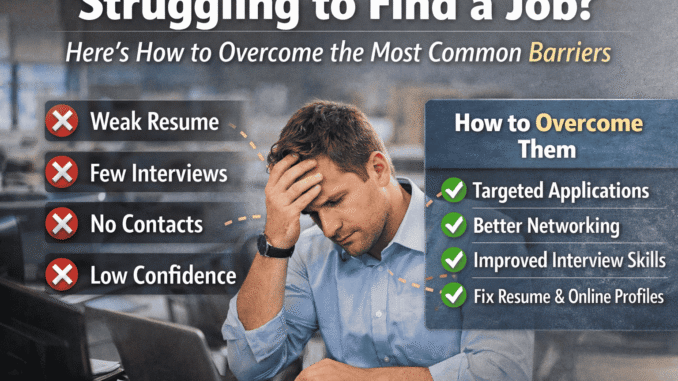
Struggling to Find a Job? You’re not alone. Many talented candidates send out countless applications with little to no response, feeling frustrated, stuck, and unsure why. The truth is, job searching isn’t just about qualifications—it’s about navigating hidden barriers that can block even the most capable applicants.
This guide reveals the most common obstacles keeping you from landing interviews and provides clear, actionable strategies to overcome them. If you’re struggling to find a job? these tips will help you break through the barriers and move confidently toward your next opportunity.
1. Understanding Why Job Searches Stall
Before fixing the problem, it’s important to understand this truth:
A lack of job offers does not mean a lack of ability.
Modern hiring is influenced by automated systems, market conditions, networking dynamics, and employer biases. Recognizing these realities helps you approach your job search strategically rather than emotionally.
2. Barrier #1: An Unclear Job Target
The Problem
Many job seekers apply to “anything available,” hoping something will stick. Unfortunately, this often leads to:
-
Generic CVs
-
Weak cover letters
-
Confused interviews
-
Low response rates
Employers favor candidates who know exactly what role they want.
How to Overcome It
-
Define 1–2 specific roles you’re targeting
-
List required skills and qualifications
-
Tailor your CV and applications to those roles
Clarity improves credibility.
3. Barrier #2: A Weak or Generic CV/Resume
The Problem
Recruiters spend 6–10 seconds scanning a CV. Common mistakes include:
-
Long paragraphs
-
Vague responsibilities instead of achievements
-
No measurable results
How to Overcome It
-
Use achievement-focused bullet points
-
Quantify results (e.g., “increased sales by 20%”)
-
Tailor keywords to each job description
Your CV should answer one question quickly:
“Why should we interview you?”
4. Barrier #3: Applicant Tracking Systems (ATS)
The Problem
Many applications are filtered out by ATS before a human sees them due to:
-
Missing keywords
-
Poor formatting
-
Non-standard headings
How to Overcome It
-
Use standard headings (Experience, Education, Skills)
-
Match keywords from the job description
-
Avoid tables, graphics, and fancy fonts
An ATS-friendly CV increases your chances of reaching a real recruiter.
5. Barrier #4: Lack of Relevant Experience
The Problem
“Entry-level” jobs often ask for experience—creating a frustrating loop.
How to Overcome It
You do have experience—just not always labeled correctly.
-
Highlight internships, volunteering, freelance work
-
Include academic projects and case studies
-
Take short certifications or online courses
Experience is about skills applied, not just job titles.
6. Barrier #5: Poor Networking (or No Networking at All)
The Problem
Many job seekers rely solely on online applications. However:
-
A large percentage of roles are filled through referrals
-
Networking increases trust and visibility
How to Overcome It
-
Update and optimize your LinkedIn profile
-
Reach out to alumni or industry professionals
-
Attend career events, webinars, or meetups
Networking is relationship-building, not begging.
7. Barrier #6: Weak Interview Performance
The Problem
You get interviews—but no offers. Common reasons include:
-
Rambling answers
-
Lack of confidence
-
Poor examples
How to Overcome It
-
Practice STAR method (Situation, Task, Action, Result)
-
Research the company thoroughly
-
Prepare answers to common behavioral questions
Interviews are a skill, not a talent—skills can be trained.
8. Barrier #7: Low Confidence and Job Search Burnout
The Problem
Repeated rejection can lead to:
-
Self-doubt
-
Procrastination
-
Negative self-talk
This mindset often shows in applications and interviews.
How to Overcome It
-
Take short breaks to reset
-
Track small wins (interviews, callbacks)
-
Focus on progress, not perfection
Confidence grows from preparation and persistence.
9. Barrier #8: Poor Online Presence
The Problem
Recruiters often search candidates online. Red flags include:
-
Incomplete LinkedIn profiles
-
Unprofessional posts
-
Inconsistencies between CV and online profiles
How to Overcome It
-
Keep your LinkedIn profile up to date
-
Use a professional photo
-
Align your CV and online information
Your online presence should support, not sabotage, your job search.
10. Barrier #9: Limited Job Search Strategy
The Problem
Applying randomly or inconsistently reduces results.
How to Overcome It
-
Create a weekly job search schedule
-
Set daily or weekly application goals
-
Track applications and follow-ups
A structured job search is more effective—and less stressful.
11. Barrier #10: Market and Economic Conditions
The Problem
Sometimes, the issue isn’t you—it’s the market:
-
Hiring freezes
-
High competition
-
Industry downturns
How to Overcome It
-
Broaden your search slightly (adjacent roles)
-
Upskill in high-demand areas
-
Consider contract or remote roles
Flexibility increases opportunity.
12. Turning Barriers into a Winning Strategy
Instead of viewing barriers as failures, treat them as feedback:
| Barrier | What It Tells You |
|---|---|
| No callbacks | CV or targeting issue |
| Interviews but no offers | Interview performance |
| Few openings | Market conditions |
| Burnout | Need for balance |
Adjusting strategy beats repeating the same approach.
13. A Simple Job Search Action Plan
Weekly Checklist:
-
Update CV for targeted roles
-
Apply to 5–10 well-matched jobs
-
Network with 3–5 professionals
-
Practice interview questions
-
Reflect and refine
Consistency compounds results.
14. Final Thoughts
Struggling to find a job doesn’t mean you’re failing—it means you’re navigating a complex system that requires strategy, resilience, and adaptability.
By identifying the real barriers in your job search and addressing them one by one, you regain control of the process. Progress may not be instant, but with the right approach, it becomes inevitable.
Remember:
The goal isn’t just to get any job—it’s to get the right one.