
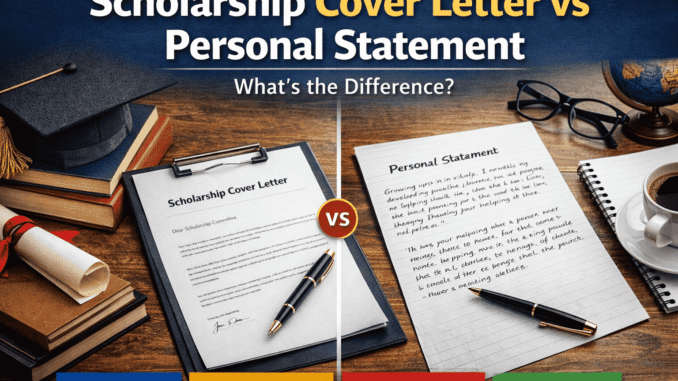
In the competitive landscape of academic scholarships, your written application materials determine whether your name advances to the next stage—or gets passed over. Among these materials, the scholarship cover letter and the personal statement are two of the most misunderstood and underutilized pieces of writing. Despite their overlap in purpose—to showcase you as a compelling candidate for financial support—each serves a distinct role and follows a unique form.
Understanding how a scholarship cover letter differs from a personal statement is crucial to presenting the strongest possible case to selection committees. When crafted properly, these documents complement one another, highlighting your qualifications, aspirations, values, and potential—while addressing the specific criteria of the scholarship.
This comprehensive article offers an exhaustive resource for students at every stage of the scholarship application process, providing clear definitions, side-by-side comparisons, detailed writing guidance, structural templates, real examples, and frequently asked questions. You’ll gain not only theoretical clarity but also the practical tools needed to write both documents effectively.
If you want ready-to-use templates, formatting guidance, and professional builders for both scholarship cover letters and personal statements, visit www.mycvcreator.com.
Table of Contents
-
Introduction
-
What Is a Scholarship Cover Letter?
-
What Is a Personal Statement?
-
Scholarship Cover Letter vs Personal Statement: Definition Comparison
-
Main Differences Between a Cover Letter and a Personal Statement
-
When to Use Which Document
-
Structure of an Effective Scholarship Cover Letter
-
Structure of an Effective Personal Statement
-
Tone, Style, and Voice: How They Differ
-
Content Priorities for Each Document
-
Common Mistakes to Avoid
-
Practical Examples and Breakdown
-
How Selection Committees Evaluate Each Document
-
Combining Both for a Strong Application Package
-
Tailoring Your Writing for Specific Scholarships
-
Editing, Proofreading, and Feedback Strategies
-
Frequently Asked Questions
-
Conclusion
1. Introduction
Scholarship applications often require multiple writing components. At first glance, a scholarship cover letter and a personal statement may seem interchangeable because both involve personal reflection, narrative, and persuasion. However, these are different tools with different purposes.
Imagine this scenario: You are invited to an interview. The cover letter serves much like your first greeting and introduction—formal, direct, and tailored to the specific opportunity. The personal statement, on the other hand, is more like your personal story shared over the course of the conversation—reflective, narrative, and deeply rooted in your experiences and motivations.
Too many applicants misuse one format when the other would have been more powerful. This article dispels that confusion and empowers you to write both with purpose and distinction.
2. What Is a Scholarship Cover Letter?
A scholarship cover letter is a formal introduction addressed to the scholarship selection committee. It typically accompanies the larger application package, including academic transcripts, recommendation letters, essays, and other required documents. The cover letter’s primary purpose is to:
-
Introduce you to the committee
-
Specify the scholarship you are applying for
-
Highlight your most relevant qualifications
-
Connect your goals with the mission or criteria of the scholarship
-
Provide context for the rest of your application
In essence, the scholarship cover letter functions as a professional summary and motivator for the committee to read the rest of your submission with positive attention.
Key attributes:
-
Short (usually 1 page, 300–500 words)
-
Formal tone and structure
-
Tailored to a specific scholarship
-
Highlights qualifications directly relevant to criteria
A cover letter is not a narrative autobiography. It is not a space for broad emotional reflection. Instead, it is concise, targeted, and functional, bridging your academic/professional identity and the scholarship’s expectations.
3. What Is a Personal Statement?
A personal statement is a reflective essay that explains who you are, why you are pursuing your field or goals, and why you deserve consideration. Unlike a cover letter, a personal statement:
-
Explores your personal journey, motivations, and experiences
-
Links your background to your aspirations
-
Uses narrative and reflection to convey authenticity and depth
-
May span 500–1,000+ words depending on guidelines
A personal statement provides the story behind the student. It allows committees to understand your motivations, challenges overcome, values, and future vision. It may reference personal hardships, academic passions, leadership experiences, community involvement, and transformative moments.
While a cover letter prioritizes professional alignment, a personal statement prioritizes personal meaning and connection.
4. Scholarship Cover Letter vs Personal Statement: Definition Comparison
To clarify the difference, here’s a direct comparison:
| Attribute | Scholarship Cover Letter | Personal Statement |
|---|---|---|
| Purpose | Formal introduction to the selection committee | Narrative about your personal journey and motivations |
| Length | Short (1 page) | Longer essay (often 500–1000+ words) |
| Tone | Professional, direct | Reflective, descriptive |
| Focus | Qualifications and fit | Experiences and personal meaning |
| Style | Formal letter format | Essay format |
| Customization | Highly specific to each scholarship | Can be adapted across applications |
| Content | Targeted achievements and goals | Background, values, inspirations |
5. Main Differences Between a Cover Letter and a Personal Statement
Understanding the differences helps you tailor content more effectively. The main distinctions include:
A. Tone and Style
Cover Letter:
-
Formal, concise, business-like
-
Focuses on clarity and relevance
-
Uses third-person observations about yourself (e.g., “I have achieved…”)
Personal Statement:
-
Narrative, reflective, personal
-
Evokes emotion and storytelling
-
Uses the first-person voice to share experiences and insights
B. Structure
Cover Letter:
-
Header with contact info
-
Date and recipient info
-
Salutation
-
Introduction outlining purpose
-
Body with qualifications tied to criteria
-
Conclusion with a call to action
-
Signature
Personal Statement:
-
No formal letter header
-
Introductory hook/story
-
Body paragraphs expanding personal experiences
-
Reflection and connection to goals
-
Conclusion linking personal journey to future aspirations
C. Purpose
Cover Letter:
-
Why am I applying and why should I be considered? (directly to committee)
Personal Statement:
-
Who am I and why does this matter? (through personal narrative)
6. When to Use Which Document
Cover Letter Is Required When:
-
The scholarship explicitly requests a cover letter
-
The application includes a formal submission with multiple documents
-
The committee wants a concise summary of your qualifications
Personal Statement Is Required When:
-
The application specifically asks for a personal statement or essay
-
You are applying to programs emphasizing background and motivation
-
The scholarship values community involvement, leadership, or life experiences
Often scholarships require both a cover letter and a personal statement. When this happens, it’s crucial not to repeat content verbatim. Instead, use each document strategically to reinforce different dimensions of your candidacy.
7. Structure of an Effective Scholarship Cover Letter
Below is a universally accepted, professional cover letter structure.
A. Header (Your Contact Information)
Include:
-
Full Name
-
Street Address
-
City, State, Postal Code
-
Phone Number
-
Professional Email
B. Date
Place the date below your header.
C. Recipient’s Information
Include the name and title of the scholarship coordinator, if provided.
D. Salutation
Use a formal greeting such as:
-
“Dear Scholarship Committee,”
-
“Dear Dr. Smith,”
-
“Dear Members of the Selection Panel,”
E. Opening Paragraph
State the following:
-
Scholarship name you are applying for
-
Your current academic status/field
-
One compelling reason you are a strong candidate
F. Body Paragraphs (1–2 paragraphs)
Include:
-
Key achievements
-
Relevant experience
-
Link to scholarship criteria
G. Final Paragraph
Close by:
-
Reiterating interest
-
Thanking the committee
-
Mentioning attached documents
H. Signature
Professional closing: “Sincerely,” followed by your name.
Here’s a simple template to illustrate:
For more professionally designed cover letter templates and builders that automatically format your content, visit www.mycvcreator.com.
8. Structure of an Effective Personal Statement
Personal statements vary widely by prompt, but most successful statements include:
A. Hook or Opening Narrative
Start with a compelling story or insight that captures the reader’s attention.
B. Background and Context
Explain your personal or academic background and what shaped your interests.
C. Key Experiences
Discuss pivotal moments—challenges, leadership roles, research, community service—that influenced your path.
D. Reflection
Explain what you learned and why it matters for your goals.
E. Future Aspirations
Link past experiences to future ambitions and how the scholarship supports them.
F. Conclusion
End with a powerful statement tying your narrative to your aspirations.
9. Tone, Style, and Voice: How They Differ
Cover Letter Tone
-
Formal and objective
-
Places emphasis on relevance to scholarship criteria
-
Professional vocabulary
Personal Statement Tone
-
Personal and subjective
-
Emphasis on insight and growth
-
Narrative and descriptive language
10. Content Priorities for Each Document
In a Cover Letter, Prioritize:
-
Scholarship name and fit
-
Direct relevance of achievements to criteria
-
Professional presentation
In a Personal Statement, Prioritize:
-
Personal journey and meaning
-
Growth through challenges
-
Long-term goals and motivations
11. Common Mistakes to Avoid
Cover Letter Mistakes
-
Repeating your resume verbatim
-
Generic statements not tied to criteria
-
Too long (exceeds one page)
Personal Statement Mistakes
-
Lack of focus or narrative
-
Repetition of cliches
-
Talking about unrelated personal details
12. Practical Examples and Breakdown
Below are realistic example excerpts (with analysis) to show how each document differs in practice.
Example Cover Letter Excerpt
“I am applying for the Global Leaders Scholarship to support my study in International Relations at XYZ University. I have maintained a 4.8 GPA, served as president of the Model UN Club, and completed an internship with the United Nations Association…”
Analysis: Focus on specific qualifications and relevance to the scholarship.
Example Personal Statement Excerpt
“Growing up in a multilingual household taught me early that communication bridges cultures. My first Model UN conference wasn’t just a club activity—it was where I recognized my passion for diplomacy…”
Analysis: Narrative, reflective, and personal motivation driven.
13. How Selection Committees Evaluate Each Document
Cover Letters
Committees look for:
-
Clarity
-
Relevance to criteria
-
Professional tone
-
Strong match between applicant and scholarship mission
Personal Statements
Committees look for:
-
Authentic voice
-
Personal insight
-
Evidence of growth and maturity
-
Clear future vision supported by experience
14. Combining Both for a Strong Application Package
A powerful application uses both documents to reinforce and expand your story without redundancy. For instance:
-
Your cover letter cites key achievements and goals
-
Your personal statement tells the story behind those achievements and goals
This layered approach gives committees both evidence and meaning.
15. Tailoring Your Writing for Specific Scholarships
Each scholarship has unique values and criteria. Before writing:
-
Research the scholarship’s mission
-
Identify keywords or priorities
-
Customize both your cover letter and personal statement accordingly
16. Editing, Proofreading, and Feedback Strategies
No matter how strong your first draft is, editing is essential:
-
Check for grammar and clarity
-
Ensure alignment with word limits
-
Ask mentors or teachers for feedback
-
Use tools and templates from www.mycvcreator.com to polish your formatting
17. Frequently Asked Questions
Q1: Can I submit only one of these documents?
If a scholarship requires both, you must submit both—each serving a specific purpose.
Q2: Can content overlap?
Some themes may overlap, but avoid verbatim repetition. Use each to highlight different aspects.
Q3: What if no personal statement is requested?
Then focus on writing an exceptional cover letter tailored to the criteria.
18. Conclusion
Understanding the difference between a scholarship cover letter and a personal statement is essential for crafting compelling, professional, and effective applications. While both documents serve to introduce you to selection committees, they do so with different tones, structures, and purposes. The cover letter is a targeted summary of your qualifications and fit; the personal statement is your story—your motivations, experiences, and aspirations.
By mastering both formats, tailoring them to your audience, and using them strategically as part of a holistic application package, you significantly increase your chances of standing out and winning scholarships that support your academic and professional journey.
For templates, professional guidance, and cover letter and personal statement builders that simplify the writing and formatting process, visit www.mycvcreator.com.
Leave a Reply