
Introduction
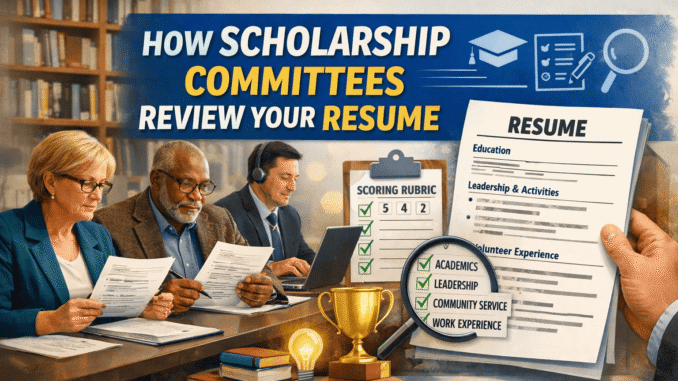
Every year, millions of students worldwide apply for scholarships—merit-based awards, need-based grants, talent recognitions, departmental awards, international fellowships, and more. In this competitive environment, understanding How Scholarship Committees Review applications can make a significant difference. Your resume often functions as the single most important document in your application, serving as a concise representation of your personal history, achievements, and future potential.
But how exactly do scholarship committees read, interpret, and evaluate resumes?
Most applicants make assumptions about this process. Some believe committees spend long hours reading every word, while others assume a strong GPA alone guarantees funding. The reality is that the scholarship review process is structured, intentional, and often standardized. Committees rarely read resumes the way employers do; instead, they use specific evaluation lenses, prioritize key information, and compare applicants against detailed rubrics as well as against one another.
This article is designed to:
-
Reveal how scholarship committees actually review resumes.
-
Demystify the decision-making process.
-
Provide evidence-based strategies for optimizing your resume for these reviews.
-
Offer detailed examples, templates, and do-and-don’ts.
-
Build confidence so your application stands out for all the right reasons.
Part I — Scholarship Committee Structures
1. What Is a Scholarship Committee?
A scholarship committee is a group of individuals who oversee the selection process for awarding scholarships. Their composition varies widely:
-
Academic faculty
-
Financial aid officers
-
Donors or alumni representatives
-
Administrative staff
-
External industry reviewers (for specialized awards)
Each committee is put together based on the type of scholarship and the goals of the sponsoring organization.
2. Types of Scholarships and Reviewers
Different scholarships are evaluated differently:
| Scholarship Type | Typical Reviewer | Main Focus of Review |
|---|---|---|
| Merit-based | Faculty, Academic Board | Academic excellence, leadership |
| Need-based | Financial Aid Office | Financial circumstances, resume context |
| Talent/Arts Scholarship | Experts in relevant field | Portfolio, awards, performance |
| Research Fellowships | Professors, Researchers | Publications, research experience |
| Corporate/Industry Sponsored | Company reps + Academic advisors | Skills, experience, potential fit for industry |
| Community/Special Interest | Community leaders, advocates | Service, personal story, impact |
Each reviewer comes with priorities, biases, and frameworks—formal or informal—that guide how they evaluate resumes.
3. Committee Workflow
Scholarship committees generally follow this sequence:
Step 1 — Application Receipt & Grouping:
Applications are sorted by category—e.g., undergraduate, graduate, international, returning student.
Step 2 — Eligibility Check:
Resumes are checked for completeness (minimum GPA, required sections, format compliance).
Step 3 — Scoring or Ranking:
Many committees use rubrics with numerical points assigned to key resume areas.
Step 4 — Shortlist Creation:
Top candidates are selected based on scores.
Step 5 — Holistic Review:
Reviewers read resumes alongside essays, recommendations, transcripts, and any interviews.
Step 6 — Final Decisions:
Often these involve discussion, consensus, or committee vote.
Part II — The Resume Review Lens
4.2 Leadership
Leadership is consistently weighted heavily.
Committees look for evidence of:
✔ Positions held (President, Team Captain, Founder, Lead)
✔ Initiatives led
✔ Projects started
✔ Organizations improved
Leadership shows potential—it reflects initiative and capability beyond academics.
4.3 Service & Impact
Merely being part of a club or event is often insufficient.
Committees look for:
👉 sustained involvement
👉 measurable impact
👉 community benefit
Examples of impactful service:
-
Tutored 200+ students in underserved communities
-
Led campus recycling program reducing waste by 40%
-
Organized health awareness drives reaching 1,500 people
Service builds character and resonates emotionally with committees.
4.4 Work & Life Experience
Work experience can be a differentiator, especially for graduate or post-grad awards.
They look for:
-
Paid or unpaid internships
-
Relevant job roles
-
Work that shows growth and responsibility
-
Skills development
This matters particularly for scholarships tied to specific career paths (e.g., engineering firms, tech research grants).
4.5 Uniqueness & Personal Narrative
Competitive scholarships often assess who you are, not just what you have done.
Resumes that hint at a story—when coordinated with the application essay—can resonate deeply.
5. What Committees Don’t Spend Much Time On
Contrary to what many candidates think, committees do not analyze resumes like employers:
🔹 They aren’t looking for perfect “action verbs”
🔹 They aren’t counting lines of bullet points
🔹 They don’t judge fonts or design unless it affects readability
🔹 They won’t penalize non-traditional backgrounds
Their focus is on content and meaning, not design aesthetics.
Part III — The Step-by-Step Review Process
Let’s break down the typical resume review chronologically.
6. First Glance (The 10-Second Scan)
Almost every committee member does a quick initial scan to check:
-
Does this applicant meet basic eligibility?
-
Is the resume readable and complete?
-
Are the applicant’s academics visible immediately?
Studies show reviewers often spend less than 15 seconds on this initial pass per resume. They look for red flags and quick winners.
Here’s what jumps out on first glance:
Top-level flags
-
Format that’s unreadable
-
Missing GPA or missing dates
-
Inconsistent formatting or missing sections
Quick positives
✔ Clear academic strengths
✔ Leadership highlighted at top
✔ Relevant awards or recognition
If eligibility isn’t immediately ascertainable, committees may set the resume aside.
7. Structured Scoring Using Rubrics
Many scholarship committees use evaluation rubrics to ensure fairness:
Example scoring breakdown (typical):
| Category | Weight |
|---|---|
| Academics | 35% |
| Leadership & Initiative | 25% |
| Service & Impact | 20% |
| Work Experience | 10% |
| Additional Achievements | 10% |
Rubrics vary, but most combine quantitative and qualitative scores.
Reviewers may fill out a spreadsheet or scorecard per applicant. These scoring sheets often guide discussions later.
8. Holistic Review (Read & Interpret)
After scoring, many committees engage in a deeper, more holistic review.
Key questions reviewers ask internally:
📌 Does this resume align with the scholarship’s mission?
📌 Does the applicant show growth or resilience?
📌 Is this person a good ambassador or representative if chosen?
This stage often involves comparing resumes to essays and recommendation letters.
Part IV — What Resonates With Committees
9. Leadership That Matters
Leadership counts—but leadership with results counts more.
Examples that stand out:
✔ Founded an initiative with measurable outcomes
✔ Led teams toward real accomplishments
✔ Long-term participation leading to organizational improvement
Committees look for depth over breadth—quality of roles over quantity.
10. Purposeful Service
Service isn’t volunteering for the sake of it. Scholarship committees look for:
-
Service aligned with applicant interests
-
Long-term sustained engagement
-
Tangible community impact
Example:
❌ “Volunteered at food bank for 3 months”
✔ “Co-organized monthly food drives, served 1,200+ families over 2 years”
11. Research & Projects That Show Thinking
For academic or research-oriented scholarships, committees value:
-
Research experiences
-
Projects with defined goals and results
-
Presentations or publications
-
Cross-disciplinary collaborations
Even independent research—documented clearly—is powerful.
12. Work & Career Experience That Shows Professional Growth
Work matters when it shows:
-
Increasing responsibility
-
Skills directly linked to future aspirations
-
Leadership or mentorship roles
-
Professional impact
For many awards, real work experience distinguishes strong applicants.
Part V — Common Pitfalls That Harm Your Resume Review
Here are mistakes that cause committees to pass on otherwise qualified candidates:
13. Lack of Focus or Narrative
A resume that reads like a random list of activities sends a weak signal. Committees prefer resumes that:
✔ Show intention
✔ Tell a cohesive story
✔ Highlight progression
For example, an applicant with scattered unrelated experiences (e.g., summer camp counselor, discord moderator, retail job) without an underlying thread struggles to convey purpose unless tied to a theme.
14. Including Irrelevant or Unverified Information
Committees dislike resumes that:
-
Push unverifiable claims
-
List inflated titles without context
-
Include old, unrelated jobs with no link to goals
Every entry should have clarity: What did you do? How long? What was the impact?
15. Omitting Dates or Context
Missing dates reduce credibility. Committees assume worst-case in ambiguity.
Always include:
✔ Dates (month–year)
✔ Clear organization names
✔ Location (if relevant)
16. Poor Formatting That Affects Readability
While design isn’t everything, resumes that are:
-
Too cluttered
-
Hard to scan
-
Inconsistent in style
…will be set aside sooner than you expect.
Scholarship committees value clarity over creativity.
Part VI — Optimizing Your Resume for Scholarship Review
17. How to Structure Your Resume for Reviewers
Here’s a recommended resume structure:
-
Header & Contact Information
-
Objective or Summary (Optional, but meaningful)
-
Education
-
Academic Honors & Awards
-
Leadership & Extracurricular Involvement
-
Service or Community Engagement
-
Work Experience
-
Research / Projects / Publications
-
Skills & Certifications
-
Additional Achievements
This order prioritizes what most committees care about.
18. How to Highlight Academic Impact
Include:
-
GPA (on scale and context)
-
Relevant courses
-
Honors programs
-
Key academic awards
-
Thesis or capstone titles
Example academic entry:
BSc Mechanical Engineering
University of Abuja, Nigeria
GPA: 4.78/5.00 — Valedictorian Candidate
Honors Program (2022–present)
Senior Capstone: Solar-Powered Water Purification System
This communicates both excellence and initiative.
19. Strategic Use of Power Statements
Instead of vague bullets, use specific impact statements:
Avoid:
-
“Volunteer at community center”
Use:
-
“Co-led a weekly literacy initiative serving 150+ students over 24 months, increasing reading proficiency by 30% (pre–post assessment).”
This emphasizes results, not just participation.
20. Aligning Resume With Scholarship Mission
Every scholarship has an underlying mission.
Example:
-
Environmental scholarship → highlight sustainability projects.
-
STEM scholarship → emphasize research, competitions, labs.
-
Arts scholarship → include exhibitions, performances, portfolios.
Align your resume content with the core values of the scholarship.
Part VII — Beyond the Resume: How It Interacts With the Rest of Your Application
Scholarship committees don’t review resumes in isolation. They compare resumes to:
-
Essays
-
Recommendation letters
-
Transcripts
-
Interviews (if applicable)
Here’s how they integrate:
21. Matching Resume to Essay Story
If your essay highlights resilience, leadership, or community contributions, your resume should reflect experiences that support that narrative.
Committees look for consistency.
22. Reactions to Recommendation Letters
Letters that reinforce resume entries—including leadership, character, scholarship potential—strengthen your profile.
If a letter contradicts the resume (for example, claiming leadership difficulties), committees notice.
23. Transcripts as Verification
Transcripts confirm:
-
GPA
-
Courses taken
-
Honors
-
Academic integrity
Discrepancies between resume and transcript raise red flags and reduce credibility.
24. Interviews: Confirmation or Clarification
If shortlisted, you may be interviewed. Committees use interviews to:
-
Confirm resume claims
-
Assess communication skills
-
Gauge motivation and fit
Resumes often guide interview questions.
Part VIII — Examples: Strong vs Weak Resume Entries
25. Leadership Entry Examples
Weak
-
Member, Student Government Association (2022–2023)
Strong
-
Vice President, Student Government Association (2021–2023)
Led a cross-campus initiative that increased club funding options by 60%, serving 30+ student organizations.
26. Service Example
Weak
-
Volunteer, Local Shelter (2021–2022)
Strong
-
Volunteer Coordinator, Hope Shelter (2021–2022)
Organized daily feeding programs for 70+ residents, streamlined volunteer schedules, improved resource outreach.
27. Research Entry
Weak
-
Research Assistant, Biology Lab
Strong
-
Research Assistant, Dr. Adewale’s Molecular Biology Lab (2022–present)
Conducted gene expression analysis for malaria resistance study; co-authored poster presented at Nigeria Clinical Conference.
Part IX — Special Considerations for International Applicants
International applicants may face additional scrutiny:
28. Educational Context Differences
Committees learn to interpret:
-
Different grading systems
-
Varying institution reputations
-
Curriculum differences
Include contextual explanations where necessary.
29. Language Proficiency
If applying in non-native language contexts, include:
-
Verified language test scores (IELTS, TOEFL)
-
Duolingo, Cambridge, etc.
This strengthens credibility.
Part X — Advanced Strategies for Standout Resumes
30. Quantify Everything
Reviews love numbers.
Examples:
✔ Students mentored: 40+
✔ Fundraising: ₦500,000+
✔ Hours volunteered: 350+
✔ Events organized: 12+
Numbers tell measurable impact.
31. Use Context Where Needed
If you served in a role unfamiliar to committees (e.g., local NGOs not known internationally), provide brief context.
Example:
“Founder, Youth Development Forum — Kaduna, Nigeria (501(c)-equivalent nonprofit focusing on STEM education access).”
32. Order Matters
Put most relevant and strongest entries first—even if chronological order would change. Scholarship resumes prioritize significance over chronology.
33. Proof & Accuracy Are Mandatory
Committees verify especially competitive candidates. Ensure accuracy in:
-
Dates
-
Titles
-
Numbers
-
Claims
False or exaggerated claims are often discovered and can result in disqualification.
Part XI — FAQ: What Applicants Ask Most About Resume Reviews
34. Do committees read entire resumes?
Sometimes—only after initial screening. Many resumes are triaged quickly.
35. Do committees care about design?
Clarity matters. Fancy design does not unless it improves readability.
36. Should I tailor resumes per scholarship?
Yes—tailor your resume to the values and emphasis of each scholarship.
37. Does length matter?
Keep it concise: 1–2 pages (standard). Less is better if it’s impactful.
Conclusion: How to Think Like a Committee Member
To truly understand How Scholarship Committees Review applications, you must begin thinking the way they do. Your resume should not be treated as a simple checklist of achievements, but as a strategic communication tool designed to present your value clearly and convincingly. It should:
✔ Demonstrate your qualifications
✔ Reflect your character and integrity
✔ Tell a clear, coherent story of growth
✔ Align closely with the scholarship’s mission
✔ Highlight measurable impact and future potential
When you structure your resume around How Scholarship Committees Review candidates—focusing on clarity, relevance, and impact—you position yourself far ahead of the competition. That shift in perspective can be the difference between being a strong applicant and being a funded scholar.
Leave a Reply