
1. The Rise of AI and Human–Machine Collaboration
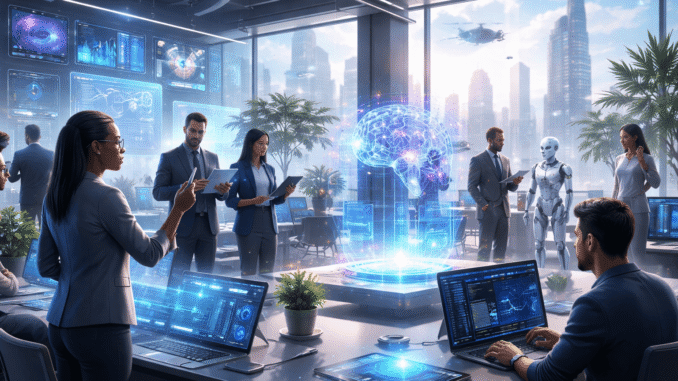
Artificial intelligence is no longer a futuristic concept—it is a core driver of workplace transformation. By , AI has evolved from a tool into a collaborative partner in many professions.
AI Is Reshaping Tasks, Not Just Jobs
One of the most important shifts is that AI is not simply replacing entire jobs—it is restructuring tasks within jobs.
- Routine and repetitive tasks are increasingly automated
- Creative, strategic, and interpersonal tasks are becoming more valuable
- Workers are expected to supervise, guide, and collaborate with AI systems
According to research, AI adoption is accelerating across industries, with task-specific AI agents expected to be embedded in up to 40% of enterprise applications by 2026 .
Human + AI = “Centaur Work”
A new model is emerging often called “centaur work”—where humans and AI systems work together:
- Writers co-create content with AI tools
- Engineers use AI to generate and test code
- Doctors leverage AI for diagnostics while focusing on patient care
Rather than replacing workers, AI often augments human capability, increasing productivity and expanding what individuals can achieve.
The Skill Shift Toward AI Fluency
Professionals are now expected to:
- Understand how AI systems work
- Use AI tools effectively
- Evaluate AI outputs critically
The most valuable workers in 2026 are those who combine technical fluency with human judgment .
2. The Explosion of Skills-Based Hiring
Traditional hiring models based on degrees and credentials are rapidly being replaced by skills-based hiring.
Why Degrees Are Losing Dominance
Several factors are driving this shift:
- AI is leveling the playing field by making knowledge more accessible
- Employers need specific skills, not just general education
- Rapid technological change makes static degrees less relevant
Employers increasingly prioritize:
- Demonstrated abilities
- Certifications
- Portfolio work
- Real-world experience
Skills Are Changing Faster Than Ever
The pace of skill change is accelerating dramatically. According to global workforce data:
- 39% of core skills are expected to change by 2030
- AI, data analysis, and cybersecurity are among the fastest-growing skills
This means that workers must embrace continuous learning rather than one-time education.
Micro-Credentials and Alternative Education
New forms of education are gaining traction:
- Online certifications
- Bootcamps
- Short-term training programs
- Employer-led training initiatives
These options are faster, cheaper, and more aligned with industry needs.
3. The Dominance of Hybrid and Flexible Work
By 2026, hybrid work is no longer an experiment—it is the default model for many industries.
Hybrid Work Becomes Standard
Research shows:
- Nearly 80% of employees who can work remotely do so at least part-time
- Hybrid work is now the most common arrangement for knowledge workers
Employees expect flexibility, and companies that fail to offer it risk losing talent.
The Benefits of Flexible Work
Hybrid work delivers:
- Increased productivity
- Higher employee satisfaction
- Reduced operational costs
Companies can save thousands of dollars per employee annually due to reduced office expenses .
Challenges of Hybrid Work
However, hybrid work introduces new challenges:
- Communication gaps
- Collaboration difficulties
- Inequality between remote and in-office workers
Organizations must redesign workflows, communication strategies, and performance metrics to adapt.
4. The Emergence of “Polywork” and Portfolio Careers
The traditional 9-to-5 job is being replaced by multi-income, multi-role careers.
What Is Polywork?
Polywork refers to professionals engaging in:
- Multiple jobs or gigs
- Freelancing alongside full-time work
- Passion projects and side businesses
This trend is driven by:
- Digital platforms enabling remote work
- Economic uncertainty
- Desire for autonomy and flexibility
The Rise of Portfolio Careers
Instead of a single career path, individuals now build career portfolios:
- A software engineer may also be a content creator
- A marketer may run an e-commerce store
- A teacher may offer online courses
This diversification reduces risk and increases income opportunities.
Implications for Employers
Companies must adapt to:
- Employees with multiple commitments
- Freelancers and contractors
- Non-linear career paths
This leads to more flexible employment models.
5. The Shift Toward Purpose-Driven Work
Employees in 2026 are not just working for money—they are seeking meaning and purpose.
The Demand for Meaningful Work
Workers increasingly prioritize:
- Social impact
- Environmental responsibility
- Ethical leadership
Organizations that align with these values are more attractive to talent.
The Role of Corporate Responsibility
Companies are expected to:
- Address climate change
- Promote diversity and inclusion
- Contribute to society
Purpose-driven organizations have a competitive advantage in attracting and retaining employees.
6. The Acceleration of Automation and Job Transformation
Automation continues to reshape industries, but its impact is more nuanced than simple job loss.
Which Jobs Are Most Affected?
AI and automation primarily impact:
- Administrative roles
- Customer service jobs
- Routine manual tasks
Surveys indicate that AI is expected to reduce some routine jobs while enhancing skilled roles .
Job Creation vs Job Displacement
While some jobs are disappearing, new roles are emerging:
- AI trainers
- Data analysts
- Cybersecurity specialists
- Automation engineers
Historically, technology creates more jobs than it destroys—but requires reskilling.
The Rise of New Job Categories
Entirely new professions are emerging, such as:
- Prompt engineers
- AI ethicists
- Digital workflow managers
These roles did not exist a decade ago.
7. The Growing Importance of Soft Skills
As automation handles technical tasks, human skills are becoming more valuable.
The Most In-Demand Soft Skills
Key skills in 2026 include:
- Critical thinking
- Emotional intelligence
- Communication
- Creativity
- Adaptability
Why Soft Skills Matter More Than Ever
AI can process data, but it cannot fully replicate:
- Empathy
- Leadership
- Ethical decision-making
Organizations are prioritizing these uniquely human capabilities.
8. The Expansion of the Gig and Freelance Economy
Freelancing is no longer a side option—it is becoming a mainstream career path.
Why Freelancing Is Growing
Factors driving this trend include:
- Remote work technologies
- Desire for independence
- Access to global clients
The Benefits of Freelancing
Freelancers enjoy:
- Flexible schedules
- Diverse projects
- Potentially higher earnings
The Challenges
However, freelancing also brings:
- Income instability
- Lack of benefits
- Increased competition
Governments and companies are exploring new ways to support gig workers.
9. The Rise of Digital Nomadism
Location independence is becoming a defining feature of modern careers.
What Is Digital Nomadism?
Digital nomads work remotely while traveling, enabled by:
- Cloud technologies
- High-speed internet
- Remote collaboration tools
Why It’s Growing
Workers value:
- Freedom
- Cultural experiences
- Work-life balance
Implications for Companies
Organizations must manage:
- Distributed teams
- Time zone differences
- Cross-cultural communication
10. The Evolution of Leadership and Management
Leadership is undergoing a fundamental transformation.
From Command-and-Control to Coaching
Traditional leadership models are being replaced by:
- Coaching and mentoring
- Empowering employees
- Facilitating collaboration
Continuous Feedback Culture
Annual performance reviews are becoming obsolete. Instead:
- Continuous feedback systems are emerging
- Real-time performance tracking is increasing
Managing Hybrid Teams
Leaders must develop new skills:
- Remote team management
- Digital communication
- Building trust without physical presence
11. The Globalization of Talent
The workforce is becoming truly global.
Borderless Hiring
Companies can now hire talent from anywhere:
- Remote work eliminates geographic barriers
- Access to global talent pools increases competitiveness
Increased Competition
Workers now compete on a global scale, requiring:
- Differentiation
- Continuous skill development
12. The Shift Toward Lifelong Learning
Education is no longer confined to early life—it is a continuous process.
Why Lifelong Learning Is Essential
Rapid change means:
- Skills become obsolete quickly
- Continuous learning is necessary to stay relevant
Learning Becomes Embedded in Work
Organizations are integrating learning into daily workflows:
- On-the-job training
- AI-powered learning platforms
- Personalized learning paths
13. The Resurgence of Skilled Trades
Interestingly, not all growth is in digital jobs.
Blue-Collar Jobs Are Making a Comeback
Due to AI and infrastructure demands:
- Electricians
- Construction workers
- Technicians
are increasingly in demand.
Recent trends show a growing shift toward vocational careers as workers seek roles less vulnerable to automation .
14. The Redefinition of Job Security
Job security in 2026 looks very different from the past.
From Stability to Employability
Instead of relying on a single employer, workers focus on:
- Transferable skills
- Professional networks
- Personal branding
Career Resilience
The goal is not job security, but career resilience—the ability to adapt and thrive amid change.
15. The Rise of Smart Workplaces
Work environments are becoming increasingly intelligent.
What Is a Smart Workplace?
Smart workplaces use:
- AI
- IoT devices
- Data analytics
to optimize productivity and employee experience.
Key Features
- Automated scheduling
- Smart meeting rooms
- Data-driven decision-making
This represents the next evolution beyond hybrid work .
Conclusion: Preparing for the Future of Work
The future of work in 2026 is shaped by adaptability, seamless technology integration, and strong human-centered skills—core elements driving The Biggest Career Shifts. These changes are not isolated developments; The Biggest Career Shifts are interconnected forces that are fundamentally transforming how we work, learn, and build sustainable careers.
Key Takeaways
- AI is transforming tasks, not just jobs
- Skills matter more than degrees
- Hybrid work is the new normal
- Careers are becoming flexible and multi-dimensional
- Continuous learning is essential
- Human skills are more valuable than ever
Final Thought
The future belongs to those who can learn, adapt, and collaborate with technology while strengthening uniquely human capabilities—an idea at the heart of The Biggest Career Shifts shaping modern work. In this evolving landscape, The Biggest Career Shifts are changing the way we think about careers, making it less about choosing a single job and more about continuous growth.
The real question is no longer “What job should I choose?” but rather “How can I keep evolving in a world where work itself is constantly changing?”
Leave a Reply