
Introduction
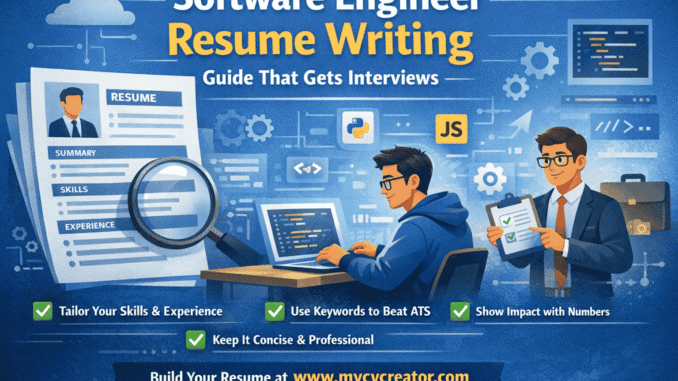
In the competitive world of technology hiring, Software Engineer Resume Writing is far more than creating a simple document — it’s about making a powerful first impression. Recruiters and hiring managers scan resumes in as little as 6–10 seconds to decide whether a candidate is worth interviewing. For software engineers, an effective resume must clearly showcase technical expertise, measurable achievements, clarity, and job relevance within that short time frame.
This guide is designed to help both entry-level and experienced software engineers master Software Engineer Resume Writing and create resumes that consistently get interviews. Whether you’re applying for internships, junior developer roles, or senior engineering positions, this resource will show you how to present your skills, experience, and value in a way employers notice and respond to.
Chapter 1 — Understanding the Purpose of a Resume
A resume is:
-
Your marketing document that sells your skills and professional story.
-
A reflection of how you solve problems and create impact.
-
A tool to pass through Applicant Tracking Systems (ATS) and reach real humans.
What a Resume Is Not
-
A complete work history (keep LinkedIn for that).
-
A personal biography.
-
A space for long paragraphs — it should be concise.
Who Reads Your Resume
-
ATS bots — looking for relevant keywords.
-
Recruiters — scanning for match to job requirements.
-
Hiring managers — evaluating technical fit.
-
Team leads/engineers — reviewing your experience and problem-solving abilities.
Each reader type expects slightly different things, but all value clarity and relevance.
Chapter 2 — Before You Write: Planning and Preparation
2.1 Define Your Target Job
Identify:
-
Job title(s) you’re applying for (e.g., Software Engineer, Backend Developer, Full Stack Engineer).
-
Required skills and experience from job descriptions.
-
Technologies and methodologies emphasized (e.g., Agile, DevOps, Cloud).
2.2 Collect Your Materials
Gather:
-
Past job descriptions.
-
Projects (including personal/academic).
-
Metrics (e.g., performance improvements, user growth).
-
Code samples or GitHub links.
-
Certifications and courses.
2.3 Identify Your Value Proposition
Ask yourself:
-
What problems did I solve?
-
What measurable results did my work produce?
-
What makes me different from other applicants?
Chapter 3 — Choosing the Right Resume Format
There are three main formats:
3.1 Reverse Chronological Resume (Most Common)
-
Lists work experience from most recent to oldest.
-
Best for professionals with consistent experience.
Example Structure
3.2 Functional/Skills-Based Resume
-
Focuses on skills rather than timeline.
-
Useful for career changers or those with gaps.
3.3 Combination Resume
-
Highlights skills and underscores experience.
-
Great for software engineers with strong technical expertise.
Chapter 4 — What to Include and How to Structure It
4.1 Header: Your Contact Information
Include:
-
Full name
-
Professional email (no nicknames)
-
LinkedIn profile
-
GitHub (or other code portfolio)
-
Personal tech portfolio or website (if available)
-
Location (City, State — optional)
Good Example
4.2 Professional Summary
A 2–3 sentence overview of who you are and what you bring.
Good Example
Tips
-
Tailor this summary for each role.
-
Include your biggest value or achievement.
Chapter 5 — Crafting the Technical Skills Section
5.1 Organizing Your Skills
Break them into categories such as:
-
Languages: Python, Java, JavaScript, C++
-
Frameworks: React, Angular, Spring Boot
-
Tools: Docker, Kubernetes, Git
-
Databases: PostgreSQL, MongoDB
-
Cloud: AWS, GCP, Azure
5.2 Tips for ATS Optimization
-
Use technical skill keywords from the job description.
-
Don’t overstuff — only include skills you’re comfortable discussing.
Chapter 6 — Building a Compelling Work Experience Section
This section convinces the reader that you’ve done meaningful work and produced value.
6.1 Use the STAR Method
Structure experience bullet points using:
-
Situation
-
Task
-
Action
-
Result
6.2 Focus on Achievements, Not Responsibilities
Weak Example
Strong Example
6.3 Include Metrics Wherever Possible
Numbers give credibility:
-
Improvement percentages
-
Performance boosts
-
User base scale
-
Budget or team size
6.4 Show Tools and Technologies
Be specific:
6.5 Present Experience for Different Career Stages
Entry-Level / Recent Graduates
-
Highlight internships, capstone projects, hackathons.
-
Show relevant coursework if lack professional experience.
Mid-Level Engineers
-
Highlight major contributions and leadership (mentoring, ownership).
Senior Engineers / Tech Leads
-
Focus on architecture decisions, mentoring, performance improvements, and system-wide impact.
Chapter 7 — Projects Section: Your Work Speaks
Projects are especially important for software engineers.
7.1 What to Include
-
Project name
-
Brief description
-
Technologies
-
Your role and impact
-
Links to code/live demo
7.2 Example Project Entry
7.3 Grouping Projects (If You Have Many)
-
Open Source Contributions
-
Independent Projects
-
Academic Projects
Chapter 8 — Education and Certifications
8.1 Education Section
List:
-
Degree
-
Institution
-
Graduation date (or expected)
-
Honors (optional)
Example
8.2 Certifications
Include certifications relevant to software engineering:
-
AWS Certified Developer
-
Google Cloud Professional
-
Scrum Master
-
Microsoft Azure
Chapter 9 — Optional Sections That Add Value
9.1 Open Source Contributions
If you have meaningful contributions to OSS projects, show them:
-
Project name
-
Your contributions
-
Impact metrics
9.2 Publications and Talks
Include:
-
Conference talks
-
Blog posts with high visibility
-
Technical articles
9.3 Awards & Honors
Mention competitive awards (Hackathon Winner, Dean’s List, etc.).
Chapter 10 — Formatting Best Practices
10.1 Length and Layout
-
1 page (entry-level)
-
1–2 pages (mid to senior)
-
Use consistent spacing, margins, and typography.
10.2 Font and Readability
-
Clear fonts: Arial, Calibri, Helvetica
-
Font size: 10–12 pt (Content), 14–16 pt (Headers)
10.3 Avoid Graphics for ATS
No images, tables, or fancy formatting that disrupts ATS parsing.
10.4 Use Bullet Points, Not Paragraphs
Bullets improve scannability.
Chapter 11 — Tailoring Your Resume to Job Descriptions
11.1 The Art of Relevance
Every time you apply:
-
Review job requirements.
-
Adjust keywords and projects to emphasize similarities.
11.2 Keywords Are Key
Add technologies mentioned in the posting only if you have experience.
11.3 Customize Your Summary
Highlight the main value that aligns with the position.
Chapter 12 — Beating Applicant Tracking Systems (ATS)
12.1 How ATS Works
ATS scans resumes for:
-
Keywords
-
Relevant experience
-
Skills matching
12.2 Tips for ATS Passing
-
Use standard section headers: “Work Experience,” “Education.”
-
Avoid graphics or text boxes.
-
Export and upload as PDF or DOCX (check job instructions).
Chapter 13 — Common Mistakes to Avoid
13.1 Too Generic
Don’t use vague terms like “worked on software.”
13.2 Lack of Metrics
Avoid statements without outcome or scale.
13.3 Typos and Grammar Errors
Proofread multiple times or use tools like Grammarly.
13.4 Including Every Job You’ve Ever Had
Only include relevant experience.
Chapter 14 — Writing for Different Software Engineering Roles
14.1 Backend Developer Resume
Emphasize:
-
Server logic
-
APIs
-
Databases
-
Microservices
14.2 Frontend Developer Resume
Highlight:
-
UI/UX implementations
-
JavaScript frameworks
-
Responsive design
14.3 Full Stack Developer Resume
Balance both client and server experience.
14.4 DevOps / Site Reliability Engineer Resume
Include:
-
CI/CD pipelines
-
Infrastructure as code
-
Monitoring tools
14.5 Machine Learning Engineer Resume
Focus on:
-
Model deployment
-
Data pipelines
-
ML frameworks like TensorFlow/PyTorch
Chapter 15 — Resume Examples and Templates
15.1 Entry-Level Software Engineer Example
(Sample text with bullets emphasizing impact.)
15.2 Mid-Level Software Engineer Example
(Detailed experience section with metrics.)
15.3 Senior Software Engineer Example
(Leadership, design, architecture scope.)
Chapter 16 — How to Write a Cover Letter that Complements Your Resume
Cover letters are optional but can help you stand out.
16.1 Structure
-
Intro: Why you’re applying
-
Body: Your relevant experience
-
Conclusion: Call to action
16.2 What to Include
-
One key achievement
-
A connection to the company’s mission or product
Chapter 17 — LinkedIn and Resume Alignment
17.1 Why It Matters
Recruiters compare both.
17.2 Tips
Use similar language, summary, and key achievements.
Chapter 18 — How to Prepare for Interviews After Your Resume Works
Your resume opens the door — now be ready for:
-
Technical interviews
-
Coding challenges
-
Behavioral interviews
18.1 Practice Coding Platforms
-
LeetCode
-
HackerRank
-
CodeSignal
18.2 System Design Prep
Study:
-
Scaling
-
Distributed systems
18.3 Behavioral Interviews
Use STAR method in answers.
Chapter 19 — Continuous Resume Improvements
19.1 Keep It Updated
Add new achievements as soon as they happen.
19.2 Track Responses
If you’re not getting interviews, revise:
-
Keywords
-
Summary
-
Experience bullets
Conclusion
A software engineer’s resume is one of the most powerful tools for career growth, and mastering Software Engineer Resume Writing can significantly increase your chances of landing interviews. With the right structure, tailored experience, measurable results, and strategic use of keywords, your resume can stand out in both applicant tracking systems and the eyes of hiring managers. Always remember to:
✔ Be clear and concise
✔ Focus on impact and results
✔ Customize your resume for each role
✔ Avoid common resume mistakes
✔ Keep your resume updated regularly
For a faster and more professional Software Engineer Resume Writing experience, along with practical templates and ATS-friendly design tools, visit www.mycvcreator.com and start building a resume that gets results.
Leave a Reply