
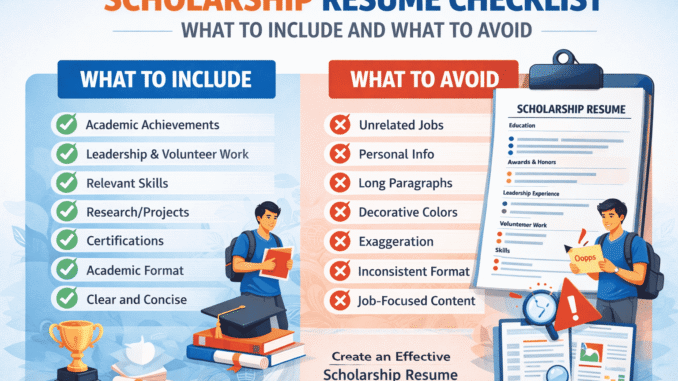
A scholarship application is only as strong as the documents that support it, and among them, the resume plays a decisive role. In today’s highly competitive academic landscape, thousands of qualified students compete for the same funding opportunities, making presentation just as important as performance. Using a well-organized Scholarship Resume Checklist helps ensure your resume clearly communicates your achievements, leadership experience, and future potential—factors that often determine whether an application is shortlisted or rejected.
This is where a structured approach becomes essential. A scholarship resume is not the same as a job resume or a general academic CV; it is a carefully curated document designed to highlight merit, impact, personal growth, and long-term promise within a limited space. Every section must be intentional, relevant, and aligned with what scholarship committees value most.
This comprehensive guide provides an in-depth Scholarship Resume Checklist, explaining exactly what to include, what to emphasize, what to remove, and what to avoid when preparing a scholarship resume for 2026 and beyond. Whether you are applying for undergraduate, postgraduate, government-funded, or international scholarships, this checklist will help you avoid common mistakes and significantly improve your chances of success.
For students who want professionally designed, scholarship-ready resume templates that follow global standards, platforms like www.mycvcreator.com offer reliable tools that simplify the process and save valuable time.
Understanding the Purpose of a Scholarship Resume
Before applying any checklist, it is important to understand why scholarship resumes exist and how they are evaluated.
Scholarship committees use resumes to:
-
Quickly assess academic merit
-
Identify leadership potential
-
Evaluate consistency in excellence
-
Measure community and social impact
-
Understand long-term goals and alignment with the scholarship’s mission
Unlike employers, scholarship providers are not hiring you for a job. They are investing in your future. As a result, the resume must tell a story of growth, discipline, service, and promise.
A strong Scholarship Resume Checklist ensures that every section of your resume supports this narrative.
Why You Need a Scholarship Resume Checklist
Many students lose scholarships not because they are unqualified, but because they submit resumes that are:
-
Poorly structured
-
Too job-focused
-
Filled with irrelevant information
-
Hard to scan
-
Not aligned with scholarship criteria
A Scholarship Resume Checklist acts as a quality-control tool that helps you:
-
Include all required sections
-
Eliminate unnecessary content
-
Maintain academic professionalism
-
Meet international formatting standards
-
Customize resumes effectively
In 2026, when scholarship applications are increasingly digitized and competitive, using a checklist is no longer optional—it is essential.
Section 1: Scholarship Resume Checklist – What You Must Include
This section covers every component that should appear in a strong scholarship resume, along with explanations and best practices.
1. Header Information (Essential)
What to Include
-
Full legal name
-
Professional email address
-
Phone number (with country code)
-
Country of residence
Why It Matters
The header is the first thing reviewers see. It must be clear, professional, and complete. Missing or unprofessional contact details can immediately weaken your application.
What to Avoid
-
Nicknames
-
Unprofessional email addresses
-
Photos (unless explicitly required)
-
Date of birth
-
Marital status
-
Religion
A clean header is a fundamental item on every Scholarship Resume Checklist.
2. Academic Profile / Education Section
What to Include
-
Degree or qualification
-
Field of study
-
Institution name
-
Location (country)
-
Expected or completed graduation date
-
GPA or academic standing (if strong)
Why It Matters
Scholarships are primarily academic investments. This section confirms your eligibility and academic seriousness.
Best Practices
-
Place education near the top
-
Use reverse chronological order
-
Include GPA only if competitive
-
Add academic distinctions where relevant
Optional Additions
-
Relevant coursework
-
Thesis or capstone projects
-
Research focus
This section is non-negotiable in any Scholarship Resume Checklist.
3. Academic Achievements and Honors
What to Include
-
Scholarships previously received
-
Academic awards
-
Dean’s List recognitions
-
Merit-based distinctions
-
National or regional competitions
Why It Matters
Past success predicts future performance. Scholarship committees value consistency in excellence.
Best Practices
-
List awards clearly and concisely
-
Include year received
-
Avoid exaggeration
Even minor recognitions become powerful when presented correctly in a scholarship resume.
4. Leadership Experience
What to Include
-
Student government roles
-
Club leadership positions
-
Project leadership
-
Team coordination roles
-
Initiative founding or management
Why It Matters
Most scholarships aim to develop future leaders. Leadership demonstrates responsibility, influence, and impact.
How to Write Leadership Entries
-
Start with action verbs
-
Describe responsibility
-
Highlight outcomes
-
Quantify results where possible
Leadership is a core pillar of any effective Scholarship Resume Checklist.
5. Volunteer and Community Service Experience
What to Include
-
NGOs and charities
-
Community projects
-
Teaching or mentoring
-
Social impact initiatives
-
Environmental or advocacy work
Why It Matters
Scholarship providers want students who give back and create positive change.
Best Practices
-
Focus on impact, not duration
-
Describe beneficiaries
-
Show personal contribution
This section often differentiates strong candidates from average ones.
6. Research Experience (If Applicable)
What to Include
-
Academic research projects
-
Laboratory work
-
Field studies
-
Research assistant roles
-
Publications or manuscripts
Why It Matters
Especially important for postgraduate, PhD, and research-based scholarships.
Best Practices
-
Clearly define your role
-
Mention methodologies
-
Highlight outputs
Research experience strengthens intellectual credibility.
7. Projects and Academic Initiatives
What to Include
-
Capstone projects
-
Academic competitions
-
Group research projects
-
Innovation challenges
-
Independent study projects
Why It Matters
Projects show practical application of knowledge and problem-solving skills.
This section supports both academic and leadership evaluation.
8. Skills Section (Academic-Focused)
What to Include
-
Research and analytical skills
-
Writing and presentation skills
-
Technical or digital skills
-
Language proficiency (with levels)
What to Avoid
-
Generic soft skills without evidence
-
Overloading with unrelated skills
Skills must support your academic and scholarship goals.
9. Certifications and Training
What to Include
-
Academic certificates
-
Online courses (relevant only)
-
Professional development training
-
Teaching or research certifications
Why It Matters
Certifications show initiative and continuous learning.
10. Publications and Conferences (If Applicable)
What to Include
-
Journal articles
-
Conference papers
-
Poster presentations
-
Academic workshops
Why It Matters
Extremely valuable for competitive international scholarships.
11. Referees (Optional)
What to Include
-
Academic referees only
-
Name, title, institution
-
Contact information (if requested)
Best Practice
Only include referees if the scholarship explicitly asks for them.
Section 2: Scholarship Resume Checklist – What to Avoid Completely
Knowing what not to include is just as important as knowing what to include.
1. Job-Style Resume Content
Avoid:
-
Sales targets
-
Profit metrics
-
Corporate jargon
-
Job descriptions unrelated to academics
Scholarship resumes are not employment resumes.
2. Irrelevant Work Experience
Avoid:
-
Unrelated part-time jobs (unless impactful)
-
Roles with no academic or leadership relevance
If work experience is included, it must demonstrate transferable skills.
3. Personal Information That Is Not Required
Avoid Including:
-
Age
-
Gender
-
Religion
-
Marital status
-
National ID numbers
These are unnecessary and sometimes inappropriate.
4. Long Paragraphs
Why to Avoid
Scholarship reviewers scan resumes quickly.
Best Practice
-
Use bullet points
-
Keep lines concise
-
Focus on results
5. Exaggeration or False Claims
Why It’s Dangerous
-
Verification is common
-
Inconsistencies lead to disqualification
-
Integrity is critical
Always be truthful.
6. Poor Formatting and Inconsistency
Avoid:
-
Multiple fonts
-
Inconsistent spacing
-
Decorative colors
-
Graphics or icons
Professional formatting is a core rule of every Scholarship Resume Checklist.
Section 3: Formatting Rules for Scholarship Resumes
Font Recommendations
-
Calibri
-
Arial
-
Times New Roman
-
Garamond
Font Size
-
Headings: 13–16 pt
-
Body text: 10.5–12 pt
Layout
-
One-column format
-
White background
-
Black or dark gray text
Section 4: Recommended Resume Length
-
Undergraduate scholarships: 1 page
-
Master’s scholarships: 1–2 pages
-
PhD and research scholarships: Up to 2 pages
Conciseness improves readability.
Section 5: Customizing Your Scholarship Resume
A strong Scholarship Resume Checklist includes customization.
Customize For:
-
Government scholarships
-
University scholarships
-
NGO or foundation scholarships
-
International scholarships
Align content with scholarship values and mission.
Section 6: Using the Right Tools to Build Your Resume
Creating a scholarship resume from scratch can be time-consuming and risky. Platforms like www.mycvcreator.com provide:
-
Scholarship-ready resume templates
-
Academic formatting
-
Easy customization
-
Export options for online portals
Using professional tools reduces errors and improves presentation.
Section 7: Final Scholarship Resume Checklist (Quick Review)
Before submitting, confirm that your resume:
✔ Is academically focused
✔ Uses professional formatting
✔ Highlights leadership and service
✔ Excludes irrelevant information
✔ Is tailored to the scholarship
✔ Is error-free and truthful
Final Thoughts
A scholarship resume is more than a summary of achievements—it is a strategic academic document. In a world where thousands of talented students compete for limited funding, clarity, relevance, and presentation matter as much as merit.
Using a structured Scholarship Resume Checklist ensures that nothing important is missing and nothing harmful is included. When combined with professional templates from platforms like www.mycvcreator.com, students can confidently submit resumes that meet international scholarship standards.
In 2026 and beyond, success belongs not only to the most qualified applicants—but to those who present their qualifications most effectively.
Leave a Reply